Litz Wire: What It Does and How to Choose It
Litz wire is made from many fine, individually insulated copper strands twisted together. It helps reduce the losses that occur when alternating current flows through a winding at high frequency, making it useful for induction heating, high-frequency transformers and wireless power coils.
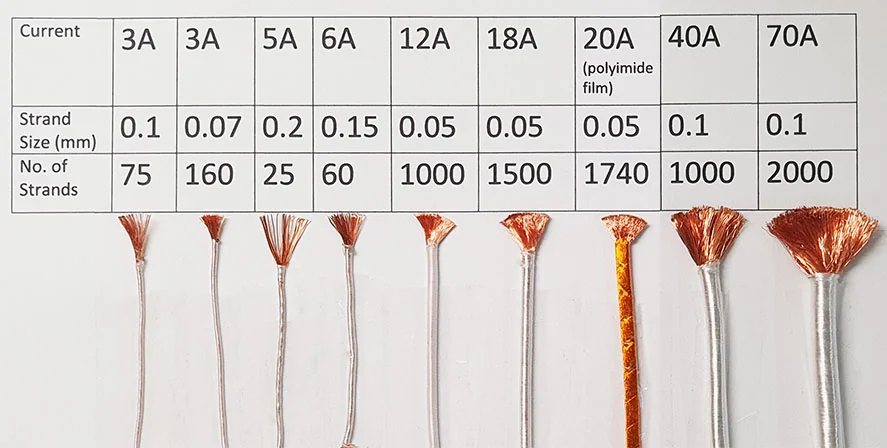
Choosing it involves two different sizes: the diameter of each strand and the size of the complete cable. Understanding that distinction makes the options much easier to compare.
Looking for wire for your project? Browse our litz wire sold by the metre, with optional soldered ends or ring terminals.
Why use litz wire?
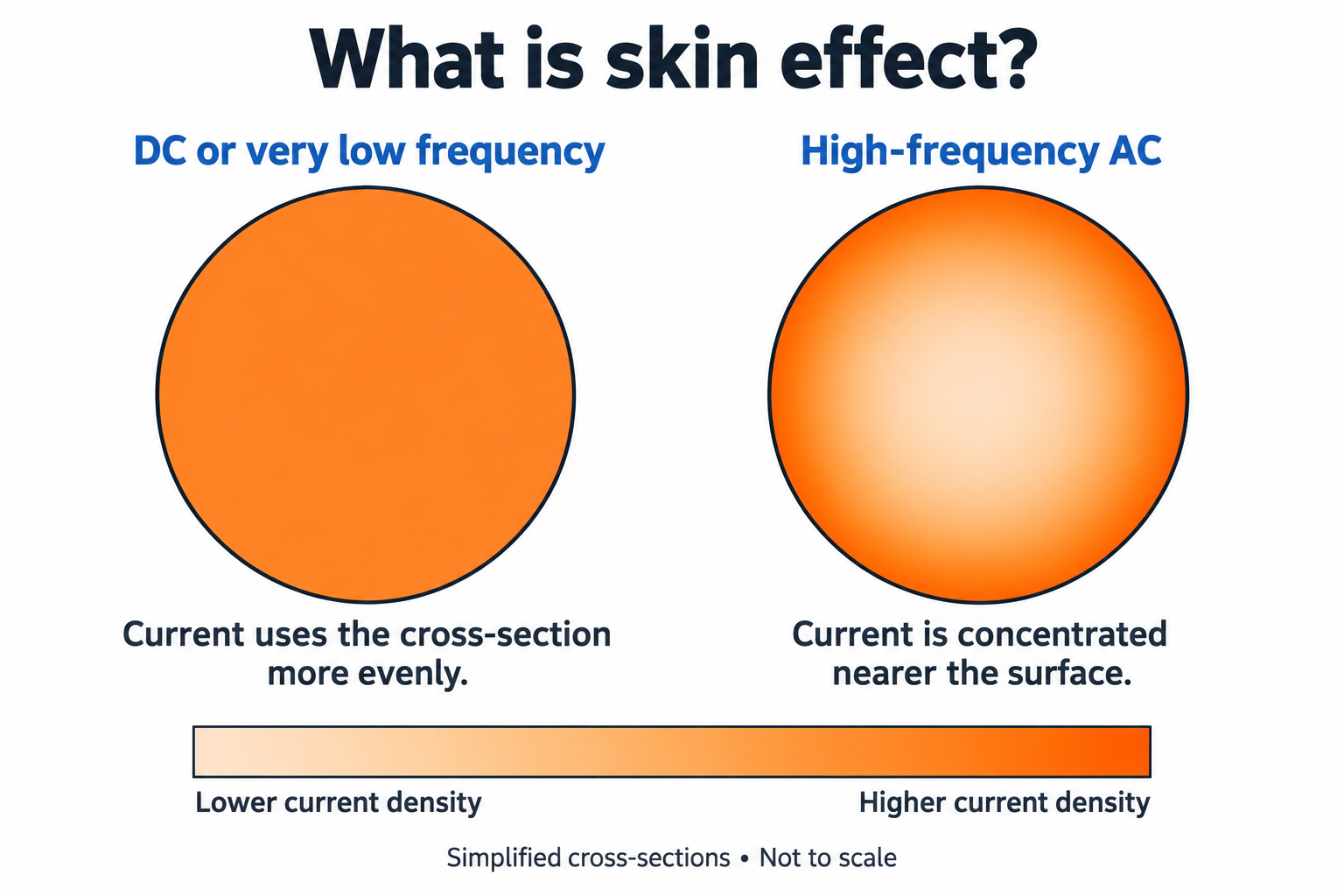
As frequency increases, current becomes concentrated closer to the surface of a conductor. This is the skin effect: less of the copper carries the current effectively, increasing AC resistance. Magnetic fields from neighbouring conductors also change the current distribution, causing additional losses known as the proximity effect.
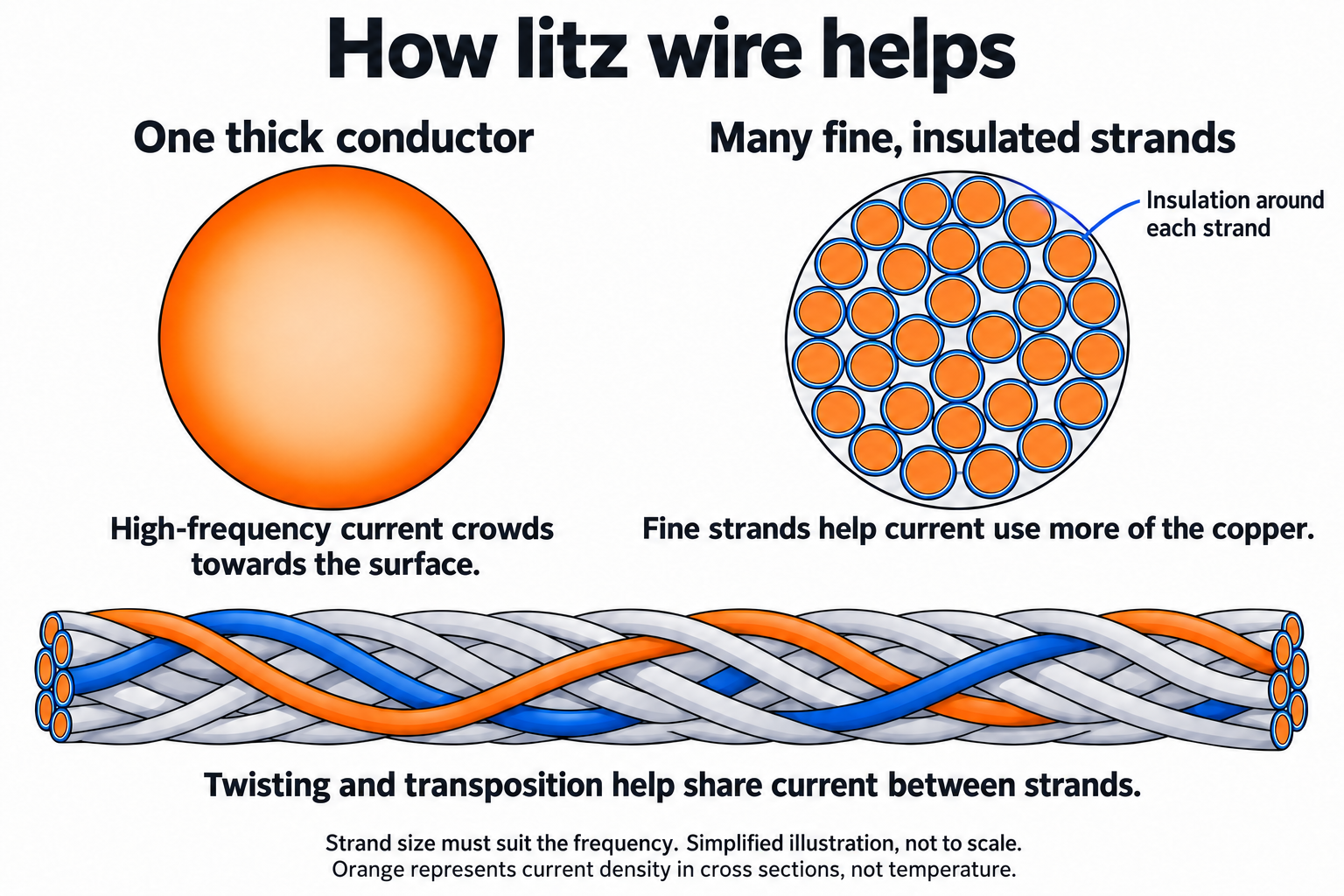
Litz construction uses individually insulated strands and a twisting pattern that changes their positions along the cable. With a suitable construction, this helps share the current between strands and reduce winding losses. Ordinary stranded hookup wire has strands in electrical contact, so it does not offer the same high-frequency behaviour.
For an illustration, this skin-effect calculator shows how skin depth changes with frequency and conductor material. Skin depth is a useful starting point; the winding arrangement also matters.
How to choose litz wire
| Consider | What to compare |
|---|---|
| Operating frequency | The diameter of each strand. Higher frequencies generally call for finer strands. |
| Current in the winding | The total copper cross-section, set by strand size and strand count. Use the current in the coil or winding, which may differ from the power-supply current. |
| Space and shape | The overall cable dimensions and insulation. Check that the chosen cable fits the winding; a rectangular profile can suit closely packed turns. |
For example, 0.05 mm × 1000 means 1,000 copper strands, each 0.05 mm in diameter. It does not describe a 0.05 mm finished cable: our 12 A reference-rated version is approximately 2.55 mm across.
The amp ratings in our range are approximate reference values. Frequency, cable length and the conditions in the finished winding affect performance. Compare the constructions in the litz wire datasheet, rather than treating an amp label as a universal limit.
Litz wire for induction heating coils
Litz wire can be wound into a coil shaped around your workpiece. Its flexibility is useful when experimenting with different coil shapes and arrangements, while the individually insulated strands help limit high-frequency winding losses.
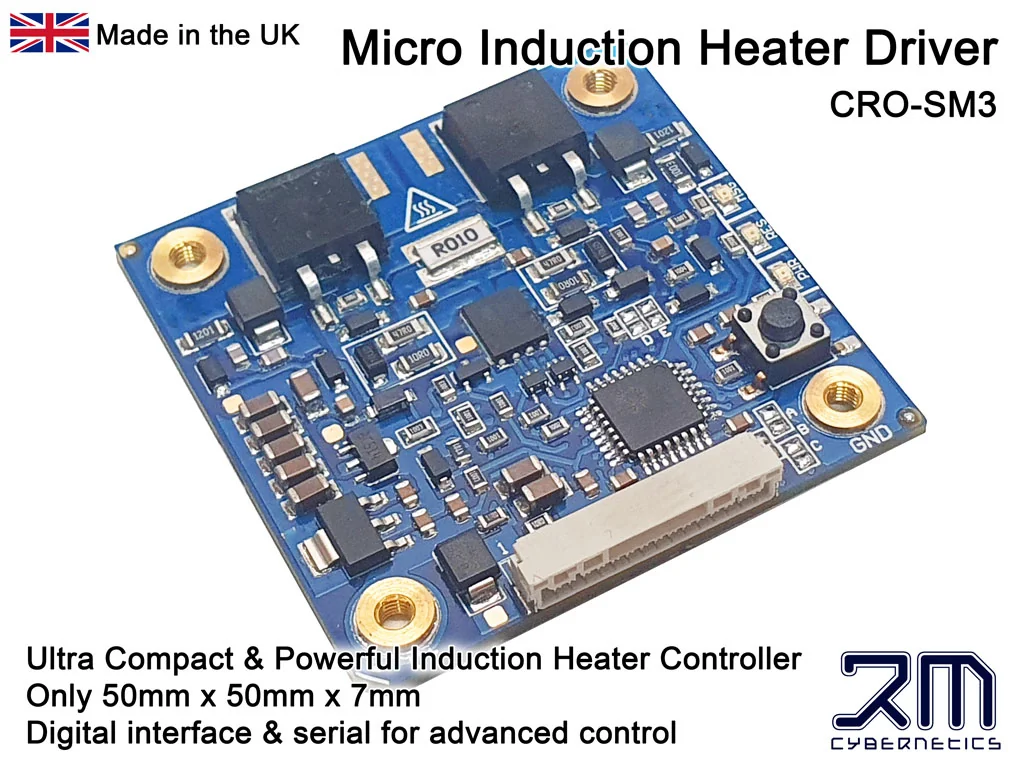
Our DIY induction heater article introduces the project. For a compact controller, see the CRO-SM3. The developer kit brings together the PRO controller and supporting components, including terminated litz wire for winding a coil.
How is litz wire soldered?
The insulation on the individual strands must be removed at the connection so that the strands make electrical contact. The appropriate preparation method depends on the enamel and cable construction; solderable enamel can be processed with suitable soldering equipment.
With hundreds or thousands of fine strands, a neat-looking joint does not necessarily mean every strand is connected. Our soldering and termination service prepares both ends of a cable, with solder-only and ring-terminal options. Order the wire separately and specify any required cut lengths in the order notes.
Can you make your own litz wire?
Small experimental bundles can be made from individually enamelled magnet wire. Commercial litz wire uses controlled strand grouping and twisting: simply twisting a bundle together does not guarantee the same high-frequency performance. Ready-made wire is convenient when you need many fine strands or a repeatable construction.
Choose wire and connections for your project
Our litz wire is sold by the metre in continuous lengths up to 100 m. Compare sizes on the product page, add termination if needed, and use the datasheet for the detailed specifications.
-
Litz Wire
Price range: $2.55 through $24.15 -

Litz Wire Soldering & Termination
Price range: $12.82 through $18.90 -
Induction Heater Circuit – CRO-SM3
Price range: $162.00 through $202.50