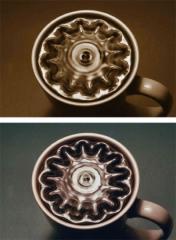
A simple vibrating platform can be made from a piezoelectric sounder mounted on a plastic tube. The piezo sounder can be connected to a signal generator or even a PC sound card. By placing a small amount of powder or fluid on the sounder, various patterns and motions can be seen depending upon the applied frequencies. This system is known as Cymatics.
This image shows a pattern formed by a fine powder vibrating at a single, mid audio range frequency. Depending upon the size of your sounder and the materials used, the patterns will emerge at a range of frequencies.
Sometimes a pattern will only remain stable at one exact frequency, whereas other patterns will emerge over a broad range frequencies. By mixing signals together more complex patterns can be formed. If you don’t have signal generators handy try using classical music as it contains a great deal of harmonics and mathematical ratios within the sounds. Other types of music may work too, but the drum beats tend to destabilize the patterns.
We now have a fantastic Cymatics device available to buy with built in audio generator which is demonstrated in the video below.
Different materials will respond in different ways to the vibrations due to varying density or particle size and shape. Materials can also be separated or made to flow through each other.
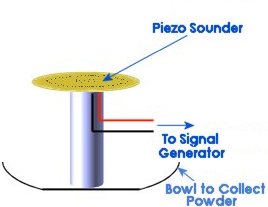
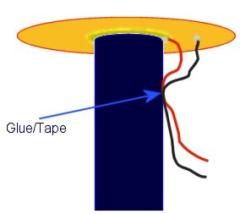
This diagram shows a flat Piezo sounder glued to the top of a small section of tubing for support. The connecting wires should be supported by attaching them to the tube. It is important that the wires are not tight as they may prevent the piezo sounder from oscillating fully. The wires can then be connected to an signal generator such as the DIY signal generator, power pulse modulator, or even a PC headphone output.
There should only be a pinch of powder such as salt placed on the sounder to see the effect. The sound should be adjusted whilst watching the surface to see how it responds. Make sure the sounder is as level as possible otherwise the powder will slide off before any patterns are formed.
You may notice that a certain frequencies the powder will jump into the air quite suddenly, destroying any patterns. This occurs due to resonance, and turning down the volume should allow you to form patterns at the resonant frequencies.
Liquids will form patterns with a very high resolution. High audio frequencies can create very fine pattern, barley visible to the naked eye. A laser beam, reflected by the vibrating surface can be used to magnify the effect. The reflected laser beam can produce an image on a screen, which will represent the vibrating surface.
-
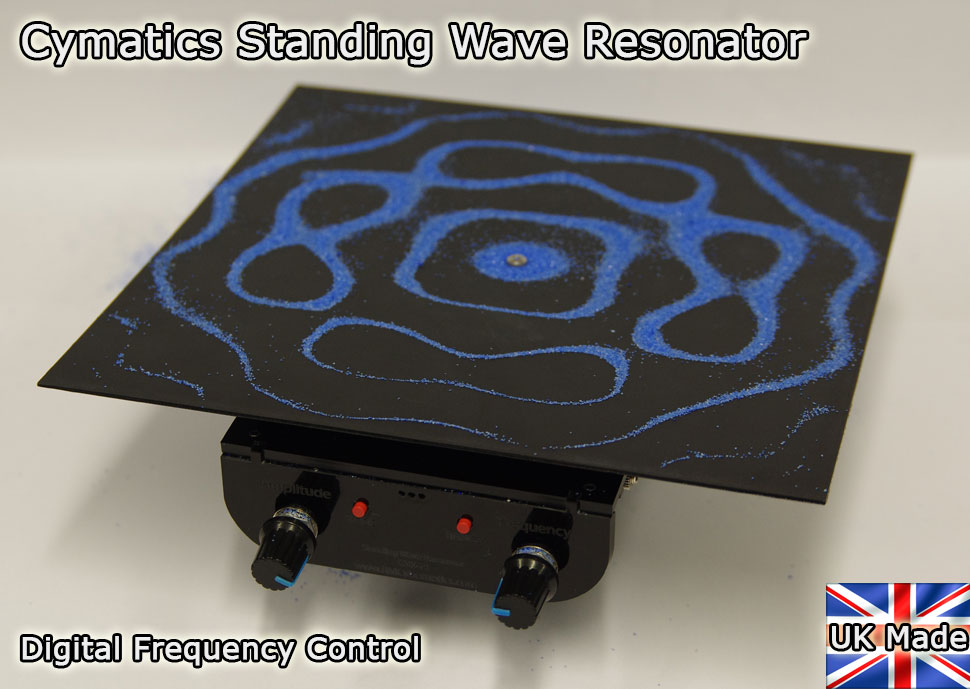
Cymatics Wave Resonator
Price range: $193.83 through $233.92 -
Custom Cymatics Vibration Plate
$26.72 -
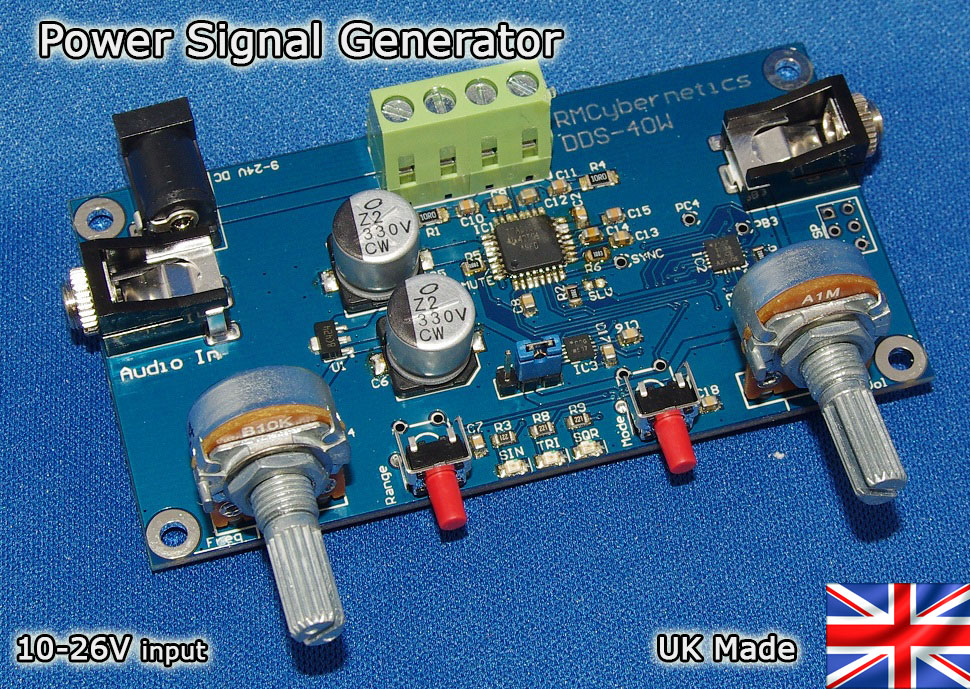
Power Signal Generator – DDS-40W
$59.21
The projected images can look like 3D holograms, and it is often quite difficult to see how the projected pattern relates to the actual pattern on the reflective material.
You can make much larger versions of this project using a speaker with a flat playe replacing part of the cone. Details are shown in the comments section below. To drive a speaker you will need an amplifier to give a good supply of power to the speaker. An alternative is to use a high power signal generator such as a power pulse controller.
If the piezo transducer is driven at very high, or ultrasonic frequencies, and with a large amplitude it is possible to ‘atomize’ liquids such as water. This creates a fine mist that resembles steam in appearance. Such mists are actually tiny droplets suspended in the air yet they behave as if they were all part of a single dense fluid medium.

Simplest for any speaker is balloon and salt- works any size ive found from 4" to 12"-
https://www.youtube.com/watch?v=odJxJRAxdFU
I have had the best results by attaching a mirror to a speaker and reflecting a laser off of it. To increase sensitivity I tried many set-ups and materials, and find the best way to get good visual displays is to attach the mirror to a spring, and attach this to the speaker. I have used hot glue to a tiny speaker, and did not have to modify the speaker at all. The spring needs to be a bit slinky and boingy and not too stiff, but enough to hold up the mirror. Small round craft mirrors about 1/2″ work great, or even a piece of broken mirror works well if thin enough glass. Even better than that is to use silicon, like in those soft toy things like wall crawlers or stretchy squishy things. I cut inch size sections from a silicone worm thing and used that instead of a spring. The only glue that works for this is a cyanocrylate. I used zap, but I assume super glue would work. find a computer based frequency generator, preferably that can do multiple freqs, or plug a guitar amp into it. That’s my original design and I am sharing it here now, so if anyone gets rich off of it, please feel free to share. Any questions are welcome. email me at uberzoid2001@yahoo.com
Victor asked the question I was going to – so thanks for that info!
For those who would like to get some good cymatics patterns without needing to do any wiring or rebuilding of electronic components, I have had success making some good cymatics patterns with a simple wooden box which has a membrane stretched over the top and an amp inside.
Here is how I did it: I took a square box made from plywood that was 2’x2′, stretched some latex over the top (you can get black latex by the yard at certain ‘goth’ sites) – held it there with a large rubber band, the kind you can get at a hardware store.
Then, drilled some holes in the side so that the amp wires could go thru the wall of the box, and placed the amp inside in the middle. I hooked the input up to my computer and ran some music into it, put salt on the membrane and there you go.
I have found that the best surfaces for creating nice, intricate patterns so far are: thin latex material or 1/8″ thick steel or brass; but I’m sure there are lots of other surfaces that work. This is in my experience…I also have created a DIY video for making your own tonascope (for those who are even less inclined to use electronics but still want to see some designs, this an “unplugged” version of a cymatics device). you can get the tonascope video instructions for free here: http://www.cymaticsounder.com (email subscription required)
Thanks again, –Jodina
Thanks for your kind donation Victor!
There’s quite a few of those devices that will vibrate a surface. I can’t remember the name of the one I saw originally, but a Google search for “turn any surface into speaker” shows some names; IceKube, sound bug, k-box.
In reading the comments by RMCybernetics….”There are also devices you can buy that effectivley turn any flat surface (like a table or window) into a speaker.”
Does anyone know what or where this device can be obtained?
Thanks!
Has anyone tried using a 50mm piezo transducer glued to the middle of a thin piece of mylar (approx thickness of a drum head)? The size of the mylar would be approx 12 x 12 inches. In theory, I think should work…any thoughts?
The power you need depend on how much mass you want to vibrate. This mass includes that of your surface.
You will need to determine this yourself.
What size amplifier in watts would be the best to demo both speaker and piezo? I am currently using a 1/8 inch plexiglas and a 1/16 or 1/8 inch steel plate. The medium I am vibrating is silica sand. The frequencies are currently 50 to 500 hz for the speaker and 1000 to 20,000 hz for the piezo, I want to go up to 2 megahertz soon. Any help on this would be greatly appreciated. Thanks!
Great and thanks, It is nice to know that a pieze can be placed on the plate and connected to the same amplifier. I believe it is best to then figure out what frequencies you want to display…use the right speaker combinations such as a subwoofer, midrange and tweeter connected inline with 3 transfer rods from the magnet to the plate. The wattage of the speakers should be high enough to counter any attenuation due to the plate material. I think I will stay in the 200 watt range in figure out the voltage (12 volt vs 120 volt) to select the right amperage for the power supply. at 12 volts, I know I would need a 16 amp power supply, is that right? If I use 120 volts, I would only need 2 amps. Is that right?
I believe the density and elasticity of Lexan would be the best and safest to use besides a metal plate. Your thoughts? Thanks so much!
1. Actually a combination of both would be best. Speakers are great for low to mid range fequency depending on the size of it. Piezos are great for very high and ultrasonic frequencies. You may notice in Hi-Fi systems that they have several speakers of different sizes. This is so that sounds of all frequencies can be reproduced well.
2. Is that a question?
3. The power you need depend on how much mass you want to vibrate. This mass includes that of your surface.
4. Yes multiple frequencies will make more complex or moving patterns.
5. The thickness and material type depend on your input power and the frequencies you are most intersted in. Sound travels at different speeds in different mateials (faster in more dense materials and more efficiently in harder ones).
I would start out with things you have lying a round to make it as cheap as possible so that you can learn about how everything responds.
In researching how to make a Cymatic Device, I have learned that people make them different ways, therefore I have a few questions:
1. Is it better to use an audio speaker or a piezoelectric (sounder or bender)element?
Currently I have a midrange car speaker (4ohm) and a 2 inch piezo. Being that it is small compared to your example. It seems like all the piezo’s are small.
2. I currently have a 12 volt car stereo amp with 200 watts peak, bridgeable for 2 100 watt speakers or one sub-woofer speaker.
3. I also have a power supply to take the voltage (120 v USA) to 12 volts and is capable to deliver 10 amps. If I am right to get the wattage, I took 12 volts X 10 amps= 120 watts to drive the speaker..Is 100-120 watts enough to make silica sand move???
4. I have a software program called audacity which allows you to input the one frequency to listen too. Will the cymatic device handle more than one frequency, I would like to also show various harmonics too.
4. I know the thickness of the plate (plexiglas) is a consideration, which thickness is best?
Bottomline, What do you think is the best (although money is a factor) way to build a Cymatic Device?
Thanks, Vic
You would get different results by placing a box on top as it would be a different shape, and much of the vibration energy would reflect and be wasted. Might be hard to water proof it. Maybe buying some waterproof speakers would be best.
There is an artist who did a similar piece using a subwoofer submerged under glycerine. I am trying to emulate this technique. Do you know if I will need to actually submerge the sub woofer under the liquid or can I build a surface out of metal or plexi (essentially a box ontop of the sub woofer into which I will put the glycerine?
Will the surface disrupt the soundwaves too much?
If I do need to submerge the speaker, are you aware of a good approach to waterproofing it?
Thanks so much. This website and discussion is really great.
It is just a speaker. You can buy them, or they are found inside the boxed speakers of any sound system. You conect the wires up exactly as ou would to the sound system.
hi I dont quite understand this. If I use a speaker like the one you´ve shown is this something that I take from a stereo or something that I buy? Also how do I connect this to something that produces sound? Coudl you make a video of how to make this?
Your PC wont allow you to produce ultrasonic frequencies. You will need a high frequency oscillator such as our Power Pulse Modulator.
High frequencies will create tiny ripple patterns on the liquids surface. A laser beam reflected from the surface will be distorted by the patterns in the liquids surface. You just shine the laser from whatever angle fits your setup and place the screen at an equal and opposite angle.
Another question. Can I produce ultrasonic frequencies with computer software and a normal speaker or do i need to purchase specific hardware for the task??
Thanx.
Could you please explain in more detail the way liquids in high frequencies can be projected as images with a laser beam?
How can i place a laser in the vibrating surface ?
The screen will obviously be placed vertically close to the horizontal vibrating surface, correct?
Please help, i’m really interested in doing this as a project.
You just have to transver the vibrations form the speaker to a flat surface. laying the speaker down an placing perspex on top would be a start. I don’t think you will get many patterns form an electric guitar though. It works best with pure frequencies.
I need to create a cymatic device that will harness the sound produced by an electric guitar and amplifier. My technological knowledge is limited, as are my finances, but I have never been to intrigued by a project. Any insight you can proved would be very much appreciated.
The mass of the water is what determines the size of speaker needed. bigger speaker for more water.
Hello. I have a project where I wanted to make ripples appear on the water in a wide shallow plexiglass.
I was hoping to have maybe a speaker attached to it or a piezo on the bottom of the plexiglass, and those are connected to an arduino board. Would you know what the specifications of speakers I would need to achieve those effects or maybe a piezo buzzer would be easier?
A small speaker will work, but large ones are much better. No a pulse gen will not replicate the vibrations of a bow. A drawn bow makes vibrations of many harmonic frequencues.
I am doing a foundations of sound studies class and our teacher wants us to do projects. I would like to build a chlandi plate, but have little experience. Are you required to have a large speaker for the device to work? If I use pulse generator circuit and an amplier, would I be able to produce the sound that Hans Jenney with a bow? I would have a round plate cut for me, and was thinking of constructing a pin so that could be placed over the speaker. If anyone has any suggestions it would be much appreciated.
It would be difficult to get it to work well in a liquid because of the high density and incompressible nature of it.
Maybe a fluid vapour or particle suspension would be best.
Has anyone made three-dimensional forms in liquids? I first saw a Cymatics article around 1970 in the UNESCO magazine, and have been thinking of them ever since. One idea I have: oil in a jar + layer of particles + water on top; then vibrate this to cause particles to arrange in a pattern suspended between the oil and water (or other liquids). Could this be done?
The CO2 does not expand when you shake the bottle. More gas is released from the liquid which causes an increase in gas pressure in the bottle. You can agitate the liquid like this to make more gas, but agitating the gas wont really do anything.
It is posible to make co2 gas in a carbonated beverage to expand by shaking the bottle. Is it possible for a set up like this to vibrate co2 gas inside a container to cause the agitated co2 gas to expand, thereby developing a pressure.
I would like to see what kind of patterns Solfeggio frequencies will produce.. especially 528 Hz.
Are there any interesting frequencies you can suggest? I’m using flour as a medium.
For the low frequency experimants will milk you will need to have the correct depth and amount of liquid for your speaker. The frequencies they have will probably be different for you as it will depend on the volume of liquid and the size of your speaker. It will also take several secconds for the resonanting waves to appear so you wil have to keep making adjustments and be patient.
As for sand and salt, you will have to try different amounts, also diffeent shaped vibrating surfaces will make differntly shaped patterns.
I have cut out the bump from the woofer and glued plastic inside, as you said on this page, connect speaker to good amp-rec,and to PC, download SigJenny (and some others) sound generator and try to experimented. The results were poor,first I try to produce Platos solids in (liquid-milk), with this frq- 7.5, 10, 10.2, 12, 13.6 as stated on this site: http://interactivesonicspaces.interfaculty.nl/mindy_mcgovern/ Milk behived almost same on all frq, WHY? 🙁
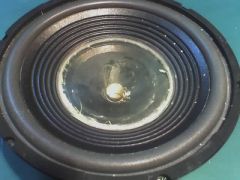
Then I tryed to higher freq. 800-2000 but sand and salt did not perform figures as they suposed to do, only circle on the center appeared and behave again almost same on all swept frq
WHAT am I doing wrong !!?
I’m not sure if this has been tried, but it could have some effect in a large volume reaction because of differing pressure regions causing different reaction rates. It wouldn’t work on a molecular scale because the wavelength of sound is too large.
This is so visually impressive that I was wondering if the effects of the sounds/frequencies applied are having effect on a molecular or atomic level – that we can’t video. In other words if we were to apply a particular frequency to a simple chemical reaction would the outcome change in any way as a result? the molecule is being influenced or held in a pattern, surely this would effect its reaction characteristics. Has anyone studied this? and if so where can I find information about it? Thank you for the information thus far.
Get a piece of plastic or cardboard and tape it over the speaker. Make sure it is firmly fixed around the edges.
I don’t have much money, but I have a fairly large speaker attached to my hifi. Could I use that without damaging it? I was thinking about placing a reasonating plate of some kind over the speaker and something to catch the particles (probably salt). Would it reasonate ok? Is there any material you would recommend for best results?
Thanks
Has anyone tried using a slowly ascending or descending Shepard-Risset Glissando in an experiment like this? I’d love to see the resulting video.
You can read more about shepard tones, scales and Shepard-Risset Glissandos in the Wikipedia article here:
http://en.wikipedia.org/wiki/Shepard_tone
You can learn the basics of different types of amplifiers here..
http://sound.westhost.com/amp-basics.htm
Hey RMCybernetics, great site you got here. I’m pretty new to all this electrical jargon, I still don’t understand what a piezoelectric transducer does after reading all the posts. Do know of any good introductory books you could suggest that describe the rudiments of amps and speakers (how they work/how they’re made) and also about basic acoustic theory? I’d like to be more electrical savvy in general.
After seeing a few clips of cymatics (specifically the video “Cymatics: Bringing Matter to Life with Sound” – found on youtube) I’ve got all these experiments running through my head that I’m really excited to try. Before I get started though (and ruin a perfectly good speaker and amp and whatever else you can screw up) I want to learn more about how amps and speakers work so I can have more control when I’m constructing my cymatics device.
Do you have any suggestions?
The sounds you hear are one frequency at a time which produces simple patterns. Music contains many frequenices and will make very complex patters. The problem is the music may change quickly so the patterns don’t get time to form. Maybe slow changing classical music would work best. Also drumbeats will disrupt it totally
hey,ive got a question…does this only work with those annoying sounds? i understand it’s the frequencies that do this,but if we use a simple rock song or something would it work? i wanna try and see what music looks like, what kind of experiment do u think would work for that??
Well I’m a Non-destructive inspector/tester. I use the ultrasonic (20k+) method as one of the primary ways of testing components for defects. If your interested look into that field for advanced theory and methods of generating vibrations and propagating them in any geo-metric configuration you choose. also with a little study you will see how an oscilloscope will show you a far more specific and accurate view of what is going on and at what frequency. I have a feeling that the properties of your Non-Newtonian fluid are due to its material velocity as pertaining to the propagation of sound waves and its meniscus properties. those properties in cooperation with sound frequency and amplitude reflect, refract and reinforce the structural integrity of the mixture, hence the hole sustaining its self and the material forming “fingers” until its strength to weight ratio causes it to succumb to structural instability and then failure. I also am interested in the propagation of lamb waves (AKA Rayliegh) which I also encourage you to look up if you want to understand this “sounder”. Furthermore, Picosecond Ultrasonic’s are another interesting phenomena…lots to study here. An overwhelming number of experiments could be performed due to the variability of the frequencies used and the material properties of the medium(s) chosen and their interactivity with one another . Another test I might encourage you to perform is one that looks into electrical current supplying the transducer to observe electrical resistance and the way that resistance is changed by the medium you are investigating and at which angels these resistances propagate, all important if your interested in maintaining your sounder and “ducer“. You would measure this in the same way you would eddy currents changing the balance of a bridge circuit, but instead of eddy’s causing variations in electrical current, it would be a physical/mechanical variance causing the distortions. anyway, i know that was a little long winded but this stuff IS cool so…
oh and what started it was the question about pizeo whatever and transducers…i suppose a transducer is something intending to transfer the sound energy into something else (atmosphere/pool of water/cornstarch/beef whatever) while the pizeo-electric crystal is a crystal that vibrates under electrical current in a predictable fashion…they are all one and the same though pending someone with a PhD insisting I’m wrong and proving it. If you have anything cool or enlightening(IE i said something you feel is inacurate or does not take into account something id like to account for.) to share feel free to contact me at myspace.com/elemental_construct
.
The vibrations need to applied to a small point on the surface. You may need to attach a rod between the center of your plate and the center of the speaker. The rod would ideally be the only thing holding up the plate.
The plate must be flat smooth and level.
If the salt is jumping, gently turn down the volume so it meerly jiggles around on the surface.
I need your help! I tried to get the patterns by placing a thin aluminium plate directly over a speaker (w/out cover), connected to an amplifier using various sounds and frequencies (downloaded from web, including the one used on youtube) – NOTHING HAPPENED! Only at certain high volumes and pitches the salt would jump – but no patterns at all. Why do you think it is not working?
I never knew it was called cymatics! My toploading washing machine has always produced concentric circles in water in a bowl placed on top when the washing machine is spinning at its fastest. Also, nearby empty cat food tins with water in, waiting to be washed, catch the vibrations and get concentric circles. What an interesting field of dicovery!
Does anyone know a means by which the reverse could be done : obtaining the vibrational frequencies (sound or other) that correspond to a known geometric pattern/body ?
On the off chance that the Rosslyn chapel code really is broken, I’m wondering how to build a sounder that would produce these patterns, only without the use of electricity. Perhaps a thin sheet of metal or glass, and the sound waves produced by a stringed musical instrument?
Would love to hear whether anyone finds something workable.
Just wanted to mention Cymatics in the news today:
“Da Vinci” Church Reveals Secret Code
Hello everyone.
I would just like to thank you for all the info. Its been extremely helpful on building my own mechanical wave driver. I have posted an instructable detailing the construction here.
Dont go spending $800 when you can build one easily.
Yes, an audio amplifier should do the trick. It’s not too difficult to make one, but you can buy pre built amplifier modules for about the same price.
Ok, so then we were thinking that we could use an audio amplifier? Do you think that we could build one or we would have to buy it?
Thanks again!
The sound from the transducer needs to be quite loud if you are to see any particles move on the surface.
Patterns will not appear at all frequencies, but if you can sweep through a broad range, then you should see some circular patterns.
Use just a few fine particles of salt at first so you can check that the transducer is being driven loud enough by your ipod. If you still see no movement then you may need a more powerful audio source.
Hi! Just today we have tried making this project. However, we used a piezoelectric transducer instead of the sounder. We successfully soldered a wire extension to a phone plug then soldered that to the transducer’s wire ending. Then we plugged it into an ipod, making sound come out of the transducer. For this project we know that we need vibrations to make the patterns, but no vibrations were seen. We can give you the specifics of the transducer, and maybe you can help us with this problem. We are not sure if we need to purchase a piezoelectric sounder, or if the frequencies are not strong enough in the music. Our resonant freqency for the trandsducer is 2500 +/- 500 Hz. If you could help us, it would be greatly appreciated!
Thank you for your continuous feedback!
Thanks to everyone for sharing your info. The answer to the question Ramona asked about the patterns that can be made can be found at the link below. This page has a Chaladini Simulator which allows you to test out the sorts of patterns you might see on a square or round vibrating surface. The simulation is based on the equation known as Chladni’s Law for Vibrating Plates
THIS IS TO BRENDON
I noticed that you wanted to duplicate the cornstarch fingers from texas institute.
based on the info they provided in the clip I derrived this
they said 120Hz at 25g acceleration is 800 ft/sec(sq) using a simple distance formula one can find that the distance traveled by the shaker is (1/12) inches. make sure that is right and make sure the frequency is 120Hz then alter the viscousity of the fluid until you get results.
I have not tried this yet so it is only in theory, but it should work.
Wow, what a load of nonsense that page is! I really hope people are not actually buying into that rubbish.
Maybe the soundbug would work better if it were attached to an ampifier, but then there is a risk of over powering it. Getting the full frequency range from one device on a large surface may be tricky. I suppose you would need to transfer the vibrations from a speaker and a piezo device to a surface. I guess Jenny used custom built equipment which will not be in the budget of a DIY project. If you just want to move small particles, then a piezo sounder should be good enough, allthough you may need an amplifier. I use this 200W amplifier from Maplin as it will drive bass speakers and even piezo sounders at ultrasonic frequencies. You can connect your audio source to this and it will step up the power considerably. It’s also short circuit protected, but it will easily destroy speakers and transducers if it’s turned up too loud.
With an amplifier you should be able to get enough power to transfer the vibrations to larger surfaces. You could extend the size of the piezo type display at the top of this page, by simply gluing a larger surface to it with epoxy resin (araldite).
Piezos work well at high freqencies which have smaller wavelengths. This means you can get very fine pattenrs even on a small surface. You will need a small amount of fine powder to see the patterns. Just crushed salt would work fine. Make sure the surface is dry and warm (room temp or above) so that moisture doesn’t cause the fine particles to stick. If you have an ultrasonic frequency source then you can even make patterns without having to hear any sound.
I bought a soundbug to try this out, and I can get salt crystals to move a little, but not really settle into any patterns. I’ve tried metal, plastic and glass sheets; metal worked best, but still nothing like the videos of the bass speakers. I tried a range of frequencies from 2Hz to 20,000Hz, and found that the salt started to vibrate at around 9,000Hz (an unpleasant, high-pitched tone!), but nottalot. I think the soundbug doesn’t have the power to really make this work well.
What I’d like to find is a way to use the whole audio range, with something powerful enough to show strong effects. However, from reading the comments, it seems the bass speaker will work fine up to perhaps 5,000Hz (though many seem not to work at less than 20Hz), while above that, a piezosounder is necessary. However, it seems too that the piezosounders are available only in relatively small sizes, so not very effective at making good, clear patterns. Equally it seems the solenoids don’t work too well; so, is there is any way of building a device that will vibrate a surface enough to make patterns visible all through the audio range? Clearly Jenny did it with the crystal oscillators, and John Reid has made something at http://www.soundhealingresource.com/cart/index.php?main_page=product_info&cPath=3&products_id=1, but that device is about 10 grand in Sterling! Any slightly cheaper way to achieve a similar effect?
Still a great page, BTW!
Piezo sounder, piezo transducer, etc are pretty much the same thing (transducer is usually used to describe ultrasonic types). These are only small and may struggle to vibrate a larger surface. It’s worth trying though. It may be better to use a thin metal sheet, glass, or another hard material with a piezo sounder, because high frequencies may get attenuated (weakened) quickly in the plastic.
If you want a nice clear display of the effect, I would suggest using a large bass speaker like the one shown in the above video clips. This will be capable of moving much more sand. A perspex/plastic sheet will be fine for this. You could do a simple test by just connecting a Hi-Fi to a PC then tip up the speakers, remove the cover, and just place a piece of plastic on top. You should be able to make some basic patterns this way by using a sine wave generator on your PC. Further improvements could then be made by fixing it more securley to the cone so it is free to vibrate.
Thank You so much for the reply!
but what we stil do not understand is that if we want to use more sand, can we glue a larger plastic surface onto the sounder and use that as our surface on which the sand will be vibrating. after reading all these comments, we still do not understand the difference between a transucer and a piezo sounder… which one should we use if we want to vibrate more sand and create visible patterns in our particles?
once again thanks so much for your feedback and appreciate it sooo much.. you really are helping us THANK YOU!
Wardlaw-Hartridge,
A piezo sounder will work at very high frequencies and thefore make patterns with a finer detail, but the sounders themselves are often quite small.
A speaker will be able to produce more vibration power but at lower frequencies.
You could add different colours of sand that also has different sized (or weight) granules. The vibrations would then seperate out the different colours in your pattern.
You could also try a square or other shaped surface. The vibrations are reflected from the edges and will therefore make different patternsd
Cymatics Experiments Update
Here is an alternative to using piezo sounders for a cymatics experiment.
These experiments were done using a large speaker that has been modified
so that it can contain powders and liquids. The speaker chosen is an 8
inch 4 ohm type that was removed from an old Hi-Fi system. The ‘bump’
from the middle part of the cone is removed so that a flat piece of plastic
can be glued in its place. This now forms a flat vibrating platform, and
the cone serves to keep everything from dropping off the edge.
To drive the speaker, a signal generator and an amplifier are needed.
A PC, some
software and Hi-Fi system would be adequate, but we used a separate
variable frequency source and a 12V
200W audio amplifier. It was necessary to have the volume very high,
particularly at higher frequencies.
Large Modified Speaker and Salt
This is a large and powerful speaker, but it is not able to produce the
very high frequencies that can be made with a piezo sounder. As the surface
vibrates, standing
waves are formed on its surface. For these standing waves to be able
to form patterns in the salt, they must have a wavelength that is smaller
than the width of the vibrating surface.
In this video you can see that as the frequency is increased (therefore
making the wavelength smaller), more rings can be seen. This is because
more wave nodes can fit on the surface.
Non-newtonian Fluid (Cornflour + Water)
We managed to get this experiment to work by using the same modified
speaker as shown above. Not much would happen at higher frequencies (presumably
because the amplitude was too low), but at low frequencies the speaker
and amplifier worked very well and could accelerate the fluid very hard.
The mixture is about 1 teaspoon of water for each heaped teaspoon of
cornflour/cornstarch. You will have to carefully tweak the amount of water
you use until you have the correct consistency. You will know it is correct
when it goes solid when you try stirring it. Just make sure its not so
thick that you can’t pour it from the container.
In this clip you can see that at the correct frequency, the fluid will
start to bunch up in the middle. If this bump is disturbed, it sets off
a chain reaction of weird creeping and morphing motions in the fluid.
hi. we were looking for a science fair project and came across this page and were immediately enthralled. the only problem is, we lack any electronic experience. what we do understand is that we have to buy a piezo electric sounder and connect to a steel plate that will be supported up by a plastic tube. but we are not sure how to connect it to our source of sound, which is our laptop and our sounder (the steel plate). we have seen videos but are not sure how much sand we should use to create patterns visible to the naked eye. what type of sounder will give us better images in the sand…a solonoid, a piezo electric sounder…? we are making three of these displays, our variable being the different frequencies in our music. is there any way we can make the display more complex or interesting to look at… we would really like to place in our science fair and would really appreciate knowing more about this amazing project. thank you.
A crystal oscillator is not the same as using the piezo transducers. It works in a similar way to this signal generator, but it uses a quartz crystal for the timing instead. Crystal oscillators are able to produce much more precise and stable frequencies.
A laptop and amplified speaker will work fine at audio frequencies, and it will allow you to mix different sounds together. A seperate signal generator will just allow you to extend the frequency range available (but will only work at a single frequency).
thanks for setting up this page! exactly what i was searching for. so i have some questions. i know hans jenny was using a crystal oscillator, is that the same as the piezo transducers from maplin’s? and in case i buy a signal generator, is there anything i need to watch out for? actually, i also tried the soundbug from my laptop and was not too happy about the results, probably an amplifier was missing. but a simple loudspeaker with amplifier plugged into my laptop did produce some relatively nice results. now i am trying to improve… .
I’ve tried a solenoid, but it was not very effective. The impedance of the coil was too high at the frequencies needed to produce the effects.
If I stepped up the voltage to overcome the impedance, much of the energy was lost to eddy currents and heat.
Maybe a specialy made solenoid with a light weight design or laminated core would be more effective.
Guys this is all very interesting, it sounds like the best source for nice strong waves would be a solonoid system.. Has anyone tried using one and got results?
I have been using Reaktor 5 to produce clean waves, once I have the correct system built I will be using this, I would recomend this to anyone looking to make and experiment with waves.
What a spectacularly fascinating webpage. Just watched Cymatics parts 1-4 from google video and am utterly entranced by this stuff. And here we have a page on how to make a device to get this in action. THANKYOU!!!
Here something i should have probably mentioned previously.
Some patterns will only form at specific frequencies, so adjustments need to be made quite slowly in order to obseve the effect.
At certian frequencies the surface used will resonate, and this will produce very pronounced movements. It’s even possible to cause all your particles to leap up and off the surface.
A simple test may be to add a pinch of salt to the surface, then brifly sweep through your frequency range. If at no point do the salt particles leap up, or make any large motion, you should assume that the vibrations are too weak, or that the material is damping the standing waves.
Also, square waves will cause harmonic vibrations too. This means for example; Your square wave input is 1 kHz, you will see 2 kHz, 3 kHz, etc as vibrations, but the harmonics are of lower amplitude. These harmonics may help or hinder the pattern formation.
With a sine wave, you have more precise control, but you will only see simple cricles as the pattern.
I noticed one particularly interesting effect when using salt particles on a piezo sounder. Very occasionaly a lone salt crystal would begin to move along the surface, gradually disintegrating and leaving a trail behind it.
The link to Maplins range of Piezo Transducers includes the sizes 27mm, 35mm, 41mm, 50mm.
The 50mm size is plenty large enough to get an idea of how the effect works. Smaller ones will work too, but it may get a little difficult to see what is happening.
the piezo transducers linked on your site are only 3.5 cm. Is this workable? Do they come larger?
Thanks mate – I will try it out with a speaker and a motor and post the results. I might email the guys from the university too to see how the did it. Appreciate your help.
This experiment was performed by researchers at the University of Texas so I really can’t say for sure if a speaker and this circuit is enough to make it work. If you try it let us know how it goes.
I suspect that you may be able to accelerate a small amount of fluid enough to see something, but I don’t think it would be the same.
I think your motor suggestion would be able to provide larger forces on the fluid, but it may be tricky to set up safley as the motor would need to be resonably powerful. The motor would need to be secured very firmly by bolting it down to the surface with a bracket. Tape or glue would be insufficient.
Thanks for your reply. I went ahead and built the DIY Signal Generator II last night so I’ll use it as the basis for the Pulse Generator Circuit you referred me to. So if I build that then connect it to a speaker will be able to move some liquids around or do you infer I’ll need to increase the voltage before it will work for liquids? Would it be easier to use this circuit to drive an electric motor with a unbalanced weight on it if I want to move liquids? If so, how do you attach the motor to a flat surface so you get the vibrations to transfer to the container holding the liquids? Sticky tape? 🙂 Basically I just want to emulate that video you had of the cornstarch/water mixture making the ‘fingers’. Thanks alot.
You would need to use an amplified signal like in the pulse generator circuit. With this you would certainly get results using powders, like sand or salt, but it may be more difficult to get a volume of liquid to respond. The circuit is designed as ‘oopen collector output’ so you could apply a higher voltage that would make the vibrations very powerful.
This is pretty cool. Just so I can get things straight before I go ahead do some experiments can you confirm a few things please? If I build the DIY Signal Generator II, then connect it to a large speaker (say 12inch), then lay a large (say 14 inchs square) flat piece of metal on top of the speaker, then place various things on top of that sheet of metal (like your dish with cornflour / cornstarch mixed with water in it), will I be able to get some good results? Or do I need to do some additional steps?
The Piezo sounders can only move small particles like sand or salt. A speaker or solenoid is neccesary for liquids or larger things.
how large of a device can the small toy piezo speakers drive
Oh god this is so incredible.. can you teach me how to build a piezo sounder / shaker for this?
Thanks!!!
The piezo sounder is just like a speaker. You would attatch it to an audio source just like you would with an ordinary speaker. The piezo sounder simply has the advantage of being flat.
It’s possible that you could jut place a metal sheet on top of a large speaker, but it would probably need to be very loud. A plastic sheet would probably vibrate more easily and allow a better frequency response.
An interesting material you can ues in cymatics experiments is a “non newtonian fluid” such as cornflour / cornstarch mixed with water.
Non newtonian fluids get stiffer when they are moved or compressed. This allows you to produce many interesing effects like shown in this video.
Hi I am a complete electronic idiot and when u say attaching the wires to piezo sounder does it mean it transmit electric current to the sounder?
Is it possible to achieve the same cymatic effects by putting a metal sheet on top of a big speaker??
and when u say connect the wires to sound card what do u mean? can u draw a diagram to help me out?
Also.. do u know of any materials that reacts with sound? as in changes or is affected by sound?
U can email me at yudabong@gmail.com
thanks so so much!
You can mount a motor under a table. If an uneven weight is attatched to the motor you can change the motor speed to change the frequency of vibration.
There are also devices you can buy that effectivley turn any flat surface (like a table or window) into a speaker.
id liek to soemthigni liek this, but on a vary large scale. Any ideas?
I am trying to make this system. I have a piezo transducer and want to work it off my pc. If I attach the wires to stereo headphone wires will this work? Also the wires are already soldered onto the disc; shall I disconnect them so that they can be attached lightly and to the tube as described?
Yes you can drive the piezo sounder directly from a PC sound card. I don’t know exactly how powerful the output will be or its frequency range, but I would expect it will be enough to move some small particles such as a pinch of salt.
The wire that comes soldered on to your sounder are probably light and flexible enough. You just need to support them in some way so that the weight of your stereo cable does not pull on the sounder. This diagram just shows a view under the sounder where the cables are glued to the support.
A piezo electric sounder is used just like a speaker to make vibrations or sound. These dvices are flatter and lighter than speakers and can therfore produce higher frequncy sound including ultrasound.
They work using special material that expands and contracts when you apply a voltage. This is known as the piezoelectric effect.
You can buy them from Maplin Electronics in the UK, or any similar type of electronics supplier.
this sounds fascinating, but what exactly is a piezoelectric sounder and where can i get one?
Electronic Transducers can be found in just about every toy that makes sound. Most of them use a small coin sized disk, this can be hooked up directly to line output on a computer or ipod and so on.
I have not found a way to use these for large scale versions yet… but its cheap and easy to find.
This cup of coffee was on a surface vibrated at approximately 20Hz by a an electric motor driving an unbalanced flywheel..