
Homemade Solar Panels
This shows a simple demonstration of how a homemade solar panel can be used to show the photoelectric effect making electricity from light. Making a solar panel this way would be no where near good enough to generate useful free energy for powering a home, but it great for demonstrating scientific principles.
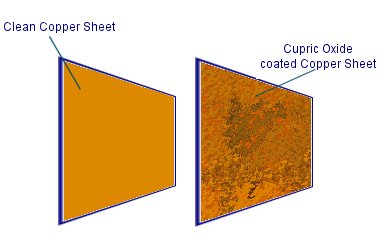 One sheet of copper is given a coating of cupric oxide as this semiconductor will convert sunlight into electricity. To do this a copper sheet is heated over a hob for around 30 minuets. When the sheet has turned black it is allowed to cool. As it cools down the black copper oxide will start to crack up and come off. this is because the materials underneath are contracting at a different rate. it is usually necessary to finish removing some of the black copper oxide by hand.
The remaining layer is covered with cupric oxide which is the important material for producing the photoelectric effect.
If the copper sheets are placed in a strong salt solution in the arrangement shown above, a small voltage will appear between the two sheets. The salt water is really just meant as an electrical conductor, but it also has the effect of making the device operate like a battery. this means it still generates small amounts of electricity even in the dark.



is it more effecient to chemically deposit the cupric oxide if yes how do i do it
Add more cells in series to add the voltages together.
how can the supply be increased beyond millivolts Ive tried it myself
If you want to collect the energy form electric or magnetic fields, this is not the way. This method uses a material that responds to photons.
Question 1: Would sunlight be the only way to activate the Cu(+1)2O coating? Could a magnetic or electrostatic field activate a current?
Question 2: Do you have anymore update information on this project?
My email: kfstevens2370@yahoo.com
My email: kfstevens2370(at)yahoo(dot)com
Yes, its a little tricky to set up, and is not too efficient. Also I expect it would take a long time to recover the energy used when heating the copper.
Using chemical deposition like you suggested would probably be better.
I’ve been studying ways to reproduce this to a greater effect and my research has led to me to reducing the Cu2O particle size to micron or nano-sized “dots”.
Instead of oxidizing the copper by brazing it with a torch, I stumbled upon the reduction of copper sulfate with a sugar (any aldose) to produce the copper(1) oxide. My understanding is that the copper(2) oxide (CuO) still exhibits semiconductance but doesn’t show the photoelectric effect with light that is commonly available.
So, by creating a solution of copper sulfate and added glucose (i have some dextrose), and mixing this in a substrate that prevents the particles from accumulating should result in a microfine powder of copper(1) oxide. I have seen work to this effect utilizing polyacrylamide that achieves particle size from 4-8nM, however I have been looking at more commonly available materials such as gelatin and agar.
At these sizes, peculiar effects have been observed including the stimulation of multiple excitons from a single quanta of light. I’m not sure if this is a wave phenomenon or what but if this stimulates multiple molecules or groups of molecules of copper(1) oxide, efficiency of the solar energy collection should greatly improve.
I have been defining the parameters of my experiments (standardizing my testing methodology to isolate single variables) and am waiting on a the arrival of the copper sulfate, leds, and glass microscope slides to study it further. My approach is to prepare the cu2o solution and fix it to the microscope slide where it is radiated by LEDs emitting light largely within a range of frequencies and observing the effects of this light on the photoelectric solution.
The idea is then to use a parabolic dish or trough to focus sunlight onto a larger cell containing this photoelectric solution and extract energy.
I know that Cu2O has low absorption in the infrared and I am interested in ways to split the focus of a paraboloid (with a beamsplitter/mirror?) such that the light that can be absorbed by the photoelectric solution is directed at that cell and infrared light is focused on a blackbody or infrared absorbing material for heat sequestration or use in another cycle (steam, sterling, etc.).
If anyone has additional thoughts about this, I would LOVE to hear them. I would especially be interested in methods of accumulating energy for rapid exhaustion later. I know if I pass current through platinum electrodes in water, I can cleave the water and form gaseous hydrogen and oxygen and later recombine those in the presence of the platinum electrodes extracting electricity but how do you store large quantities of hydrogen while reducing risks of explosion and without spending all my gathered energy to compress it into pressurized cylinders?
Have you actually conducted the experiment using oxidized copper sheeting? If so, how would you improve the process?