
DIY Supercooler
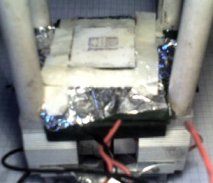 The aim of this project was to create a simple device capable of keeping components as cool as possible using common parts and materials. The device shown here is capable of maintaining a temperature of approximately -50° C.
The image on the left shows the exposed surface of a peltier heat pump which normaly sits under a well insulated containter with a metal base.
A selection of peltier heat pumps are stacked on a large heatsink (with fan) and surrounded by insulating material, except for the cold face. Using the thermoelectric effect of the Peltier elements, heat can be rapidly drawn away from this surface, but only as long as the heatsink is able to dissipate into she surrounding air. A large heatsink and fan can be found in computer shops as they are necessary for keeping your computers processor cool.
Simply sticking a component to the surface of the heat pump will provide quite effective cooling, but only if there is a large amount of contacting surface area. For more rounded or uneven shaped components, such as laser diodes, it is possible to use a very cold liquid to surround the device. This liquid must be able to withstand very low temperatures without freezing, and be highly volatile (evaporates easily). Something like liquid Nitrogen or Helium would be great, but that’s not something you can just pick up from your local hardware store. This projects uses ‘Freezer Spray’ which can usually be found in shops selling plumbing accessories. This spray evaporates rapidly on contact with room temperature objects drawing the heat way from it. By slowly spraying the Freezer Spray into a small container such as its lid, it is possible to collect it as a liquid. The liquid can be put in a small metal container which sits on the surface of the cold heat pump. This metal container is also surrounded in insulating material such as polystyrene.
When the heat pumps and fan are active it should be possible to prevent the liquid from evaporating, allowing components to be submerged for cooling.
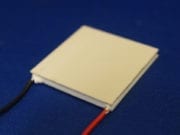
Most peltier heat pumps / thermoelectric modules require some odd non standard DC voltage (8.4 for example). While such a device would work fine on a lower voltage you would not be getting the full cooling potential of the peltier element. A good way to power these devices is by using pulse width modulation so that you can adjust precisely the average power flowing through the device. Our power pulse modulator makes an ideal power supply for peltier modules.
Available Parts: Heat Pumps, Thermal Compound, Power Control Circuits, PSU, Heatsinks


I was interested in cooling/heating a vivarium with a peltier system.
I was thinking of using a liquid PC computer cooler system (Radiator, fans, pump hoses and chip sink) on one side(or the equivalent), two copper cooling blocks a pump, heat exchange liquid and hoses on the other. One block with heat paste on the opposite side of the peltier and the other submersed in the filter sump to exchange heating/cooling there.
The water volume is about 60 gallons. The room temp is about 55 deg F normally but does vary higher and lower at times. The vivarium needs to be between 70-78 deg F reversing the polarity on the peltier chip as needed for heating or cooling.
Does this sound feasible?
Yes. We use a similar setup to cool a laser in our workshop. There is a Cooling block either side of the peltier. The cool side circukates water through the laser using a pump. The hot side has it circulated through a radiator with a fan for removing the heat. You can use our heater power calculator to work out how fast it will heat or cool your volume of water.
Try using a slurry of acetone and dry ice as your cooling bath. It’s good down to about -80 degrees.
You can get acetone from any hardware store, and dry ice isn’t all that hard to find. Some grocery stores sell it, and it’s commonly used to ship food. Both are cheap, and you’ll get a lot more value from those than you will trying to collect cooling fluid.
It is a very inefficient way of making electricity. Google around for it, there are some projects out there covering what you are interested in.
These things are so fascinating! Hope you can help me…
I am looking to generate electric with the Peltier’s modules to use for LED rope lights and other AC equipment while camping, nothing with big draw. I was going to use a inverter to convert the DC voltage to AC voltage. I need at least 12-14VDC to run through the inverter. Can you please help me in accomplishing this task aka tell me what I need and what to do…
Thank you, Ron
P.S. I attached a drawing to maybe undo the confusion
Thanks for all your help!
It is the best possible theoretical performance of the device.
With the max temp difference of a peltier unit, does that mean it won’t generate a difference of more that that or that if you allow it to do so it will break?
I’ve got 10 peltier units – if I stack them am I likely to get better efficiency in a 1-2-7 configuration (most chance of drawing all the heat out to the hottest edge quickly) or 1-3-6 (most chance of drawing all the heat away from the coolest edge quickly)? Hoping I haven’t made any silly mistakes in the logic there!
No, not at all. At absolute zero there is no energy (except zero point energy) at all. All particles stop moving, including the electrons around an atom.
Peltiers are very inefficient anyway. For serious cooling liquid nitrogen or helium is used. As it evaporates, energy is removed from the system. The expanded gas then goes back to a compressor where it is squeezed back into liquid form.
To go even colder than this, sophisticated laser systems are used to move and cool individual atoms or small groups of atoms in a vacuum. The lasers are tuned to the natural resonant frequency of the atoms so that they can interact with it and cancel out its vibrations.
Fine
so theres no way to get it to absolute 0
No. Nothing in the universe can ever get that cold!
Absolute zero (0K) is -273 Celcius
Liquid nitrogen is -196 Celcius
..no you couldn’t get to -196 this way either
Can you get this around -300degrees celcius with more peltiers
How would you set them out eg. back to back, 1 to 2 or a diagram
If you heat one ride and cool the other, it will produce electricity!
You can’t really make a peltier module at home. It is made from lots of big semiconductor junctions arranged like a thermocouple.
from what i understand is that i need a heatsink, foam insulator and a peltier module to make this device, can you explain further the procedure on how to make the peltier cooler module and what type of materails will i use? i’m looking foraward to your answer, and im planning to make this device.thanks and more power!
I’m not sure why you want to melt the foam. Is it not simpler just to cut it to fit around your design?
Power (wattage), current and voltage are all related. You usually determine one from two others. Check out the info on Ohms Law to see how to calculate the values. I highly reccomend you learn the info in the electronics section. It’s not much to read and things will become much clearer when you can see how these things relate to eachother.
I have been collecting plastic and foam to melt, If i had a 60w peltier what would it’s current and wattage draw be
Thanks
A higher power (wattage) device will gnerally be larger and therfore be capable of moving more heat. It will also generate proportionally more heat in the process.
Do you measure peltiers wattage by its cooling power
I guess so. The idea of the foam is to trap lots of pockes of air to prevent thermal conduction and convection. The best insulating materials have a low as possible density.
Could you melt styrofoam and plastic together fof its insulation
Thanks
Water cooling would be good, but its not so easy to set up. A flow of cold water through the fins of the heatsink would remove heat very effectively.
Thanks
what else could cool the hot side of the peltier quickly
No probs. It happens to us all sometimes.
It may help to spread the heat away from the heatsink, but I think this benefit would be cancelled out by the foil radiating infrared heat back into your box.
Sorry RMC
Sometimes I Get mixed up
If u connect the hot site of the peltier to the foil thats on the outside of the box would it help cool the peltier
Thanks RMC
A plastic box lined with foil on the outside would be a good container for the foam. You could cut a square hole with just enough space to fit the heatpump through. you can then fit the heatsink to the outside of the box so that the hot and cold areas are as well seperated as possible.
It may also help to have foil layers on each of the sides of the foam, but you will need to make sure that you don’t use too much, or you could end up making a path for the heat to be conducted in from the outside.
If you can find some of that plastic based foil used in survival kits, helium baloons, or for marathon runners, this would be better.
The foil is used to reflect Infrared heat, while the foam is a barrier for heat conduction and convection.
“If you put a heatsink on the cold side of the peltier module to give off more heat”
Is that a question? If it is, I guess you are asking how adding a heatsink to the cold side will effect things. If you are cooling a container of fluid(liquid or gas), then the cold heatsink will allow the heat to be drawn out of the fluid much faster because of its increased surface area. If the cold heatsink is exposed to the environment (moving air, light etc) then it will continuously absorb heat and therfore have a higher temperature overall.
If you put a heatsink on the cold side of the peltier module to give off more heat
thanks
Thanks RMC
Is there any way that you reccomend to build the Super coolers box/frame out of to provide maximum cooling inside the compartment
Thanks you’re the best RMC. I’ll reccomend you to everyone i know
There isn’t a lot to this device. The power rating or size of the heatpump you use just depends on how much heat you think you will need to move. This example used a 80W module on the heatsink with a smaller 40W on top of that, but just a single element will work fine if you can remove the heat from the hot side quickly enough. You can see a bit more info about the wiring and sizes of the heatpumps on the DIY Dehumidifier page.
The insulation can just be cut from foam or a block of polystyrene and go right to the edge of the peltier module. If a metal container (or container with a metal base) is placed onto the top of the peltier module, the heat within it will be drawn out. You will probably also need to make a nice insulated lid too.

Hello
Would you be able to provide a more precice diagram because the pic does not give me enough info
P.S What size peltier module i.e. 70W, 100W ect and how many
thanks
There is an australian catalogue (Jaycar) that sells thelarger (70w) perltier pumps fopr around £6 ($10) each. If you worked on the basis of needing three modules to pump away the heat of 1 (due to the DC power being converted to heat also), then if you purchased 13 of these, you could make a triple stack.
Level 1, 9 peltier heat pumps bonded to a big slab of copper or aluminium, ideally water cooled. Aim to keep the hot side at no more than 20 C (Cold side approx -35)
Level 2, 3 heat pumps, with a hot side at -35 ought to be able to produce a cold side of around -80 to -90 ASSUMING the junctions keep working at cold temps
Level 3, with a hot side of -85 should go very nicely below -100 on the cold side.
You will also need a car battery or two ready to provide enough DC – or a mighty powerful PSU.
I am guessing you could add a new level of 27 modules under the 9 of you had the cash to do it (and the need).
The important point here is that you need three modules to handle the output from 1 above it.
The temerature of the cold side of Peltier devices depends directly upon the temperature of the hot side. To gain better performace you must be able to move the heat away more quickly. If this side was cooled further, the temperature of the cold side would drop accordingly. Better cooling might be achived using water coolers, a vortex tube or more heat pumps.
If you stack enough units back to back, theoredically you should be able to cool to absolute zero. In practice this is not possible.
Is it possible to go colder than -50 degrees with this type of cooling method? Dry ice is not far off at -78, so could it be used to freeze carbon dioxide?