
A DIY Dehumidifier Using the Thermoelectric Effect
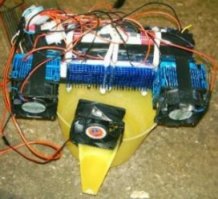
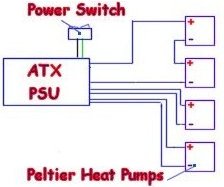
This device utilises the cooling effect of peltier heat pumps in order to extract water from the air. The device was used in a damp basement and could collect about 500ml per day. The erratic wiring in the image make this device appear much more complex than it really is. There are a large number of wires because several different sized heat pumps were used, and each requires a different voltage. The six fans all ran from 12 volts. To provide the various voltages to the device a standard 500W ATX PC power supply was used. This type of PSU can be very useful for various experiments as they can provide a range of voltages simultaneously with a reasonable power output, and they are also overload protected. An alternative to using the set voltages of an ATX PSU is to use a pulse width modulation circuit such as a power pulse modulator. This can be used to finely adjust the power to a peltier cooler so that it is operating at optimum levels.
-
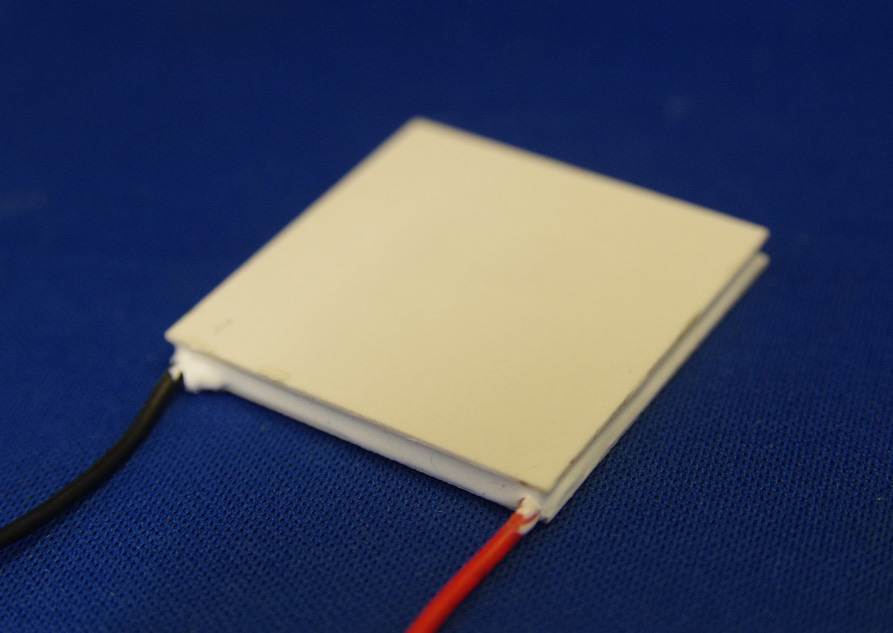
Peltier Thermoelectric Cooler 230W
$32.02 -
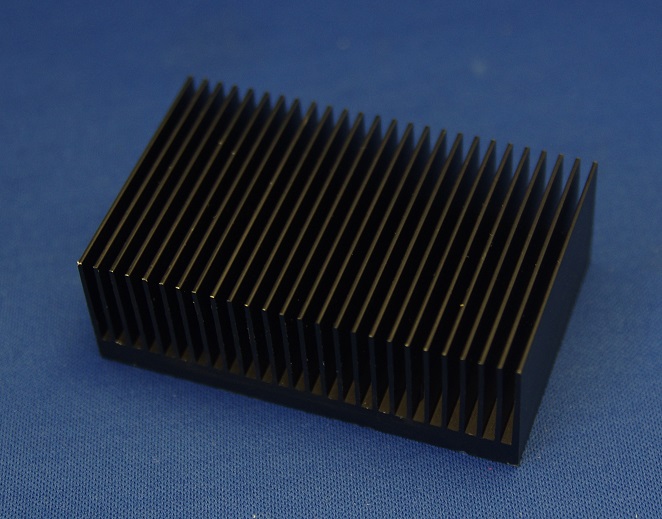
Heatsink 50x80x27mm
$24.01 -
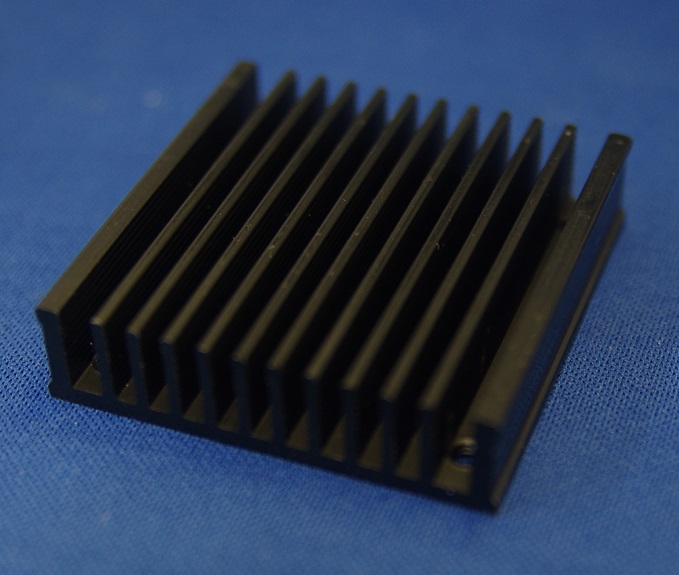
Heatsink 50 x 50 x 12.8mm
$13.33
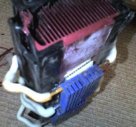
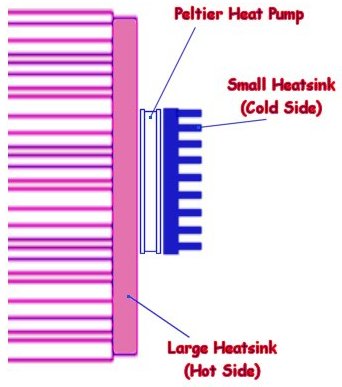
The device works by cooling the small blue heatsinks in the centre of the image. These are cooled to about 0 degrees Celsius (dependent on ambient temperature) which causes water to condense on the fins. When enough water has built up between the fins it will drip into the container below. The fan at the front simply keeps the air flowing over the cold fins, whereas the other fans are used to remove the heat from the heat pumps. In this image you can see a heat pump (peltier module) between the hot and cold heatsinks. Although this device is a useful demonstration of scientific principles, it is actually not incredibly practical or efficient.
This device is very easy to construct, and can collect a surprising amount of water for its small size. When a peltier module is attached to a DC source it will begin to move heat from one surface to the other. The side receiving the heat needs to be cooled using large heatsinks as the module itself will generate excess heat due to the current flowing in the device.

Parts were from Maplin, but the no longer sell peltier elements.
Most other electronics distributers will sell them. RS for example.
help!, my friend and i are wondering how you built it and we are struggling on how to build it could you tell me where you got the stuff
A few watts would probably be enough.
I want to build a dehumidifier that collects just a few milliliters per day (aprox. 20 ml) without using a fan? Does anybody knows how much energy y would need to make it function? thanks
About 5 x 5 x 0.4 cm
Approxamatly how big where the peltier modules you used eg. 1x4x4
One module was removed from a small fridge, while the others were random discontinued items from Maplin.
The largest module was probably like this one, while the three others were more like this one. I’m sorry I can’t be more precise, but I no longer have the peltier modules.
Hello
I know u said that u used several hundred watt modules but can u be exact on that
Thanks
20W is not enough to collect 1l per day. This example used several hundred watts.
You can find heatsinks in most computer or electronics shops.
Hi Again,
I’m Finding it really hard to obtain heatsinks,
I know that there supposed to be in computers like you wrote but i can not find any.
Is there any place that sells them really cheap and that you reccomend
Thanks
Hi
Is there a possibility you could hook a transformer up to a 20W solar panel to power a dehumidifier that gets about 1 litre of water a day, If So where could you buy the transformer and how much
Thanks
Several different sized modules were used. They were roughly between 3 and 6 cm wide and worked between 5 and 12 volts.
Hi,
I was Just wondering what size peltier module you used
Actually the heatsinks should be very easy to get hold of. The large (red) heatsinks are actually designed for use with Processors in a standard PC. This project used three strapped together side by side. The small (blue) heatsinks are designed for memory cooling and would normally be strapped to the RAM in a PC.
I was lucky to get most of the heatpumps very cheap from Maplin just as they were discontinued. The larger one was taken from the inside of one of those 12V mini fridges. It was actually cheaper to buy a whole fridge and remove one part than it was to buy a new peltier module of the same size from a local supplier.
As for power consumption, I don’t know exactly, but its a lot! Peltier cooling is a power hungry and not very efficient method, but it’s silent and compact.
I ended up using two seperate 500W ATX PSU’s to run this as with one it would periodically trip out. This doesn’t mean it was using 1kW, it’s just the particular voltage channels being used couldn’t supply enough currennt
Hi:
This is a really neat project…two questions. One, how did you source the parts? The small heatsink would be easy enough to find, but where did you get the big one? Even at surplus I’d guess it would be pretty expensive. Same with the Peltier device, is there a relatively inexpensive source for those?
Second question… Any idea how much power it uses? Thanks-
Yes you should avoid getting water between the plates as this would short circuit the elements.
It is common to seal the edges of the heatpumps with a small amount of silicon sealant.
do we need to keep the peltier dry in this setup? i.e, not get the water in between the hot/cold plates of the peltier?