
Franklin’s Bells
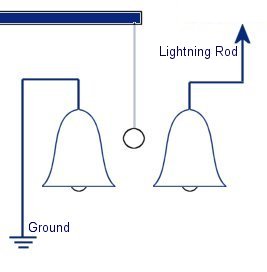 In 1752 Benjamin Franklin was experimenting with one of his inventions, the lightning rod. Using the setup shown on the left Franklin was able collect electrostatic charges from the wind above his house. No known images exist of the original setup used, but this is the most common method used to reproduce the effects he describes.
This electrostatic device was actually invented in 1742 by a German professor named Andrew Gordon. Gordon’s Bells were the first device that converted electrical energy into mechanical energy in the form of a repeating mechanical motion, opening the doors for a variety of modern technology, from security alarms to school bells.
Two metal bells are suspended on insulating (dielectric) supports. One bell is electrically connected to the earth and the other is connected to a lightning rod. A metallic ball is suspended between the bells by a dielectric thread. The lightning rod would allow charge to build up on the bell which would then attract the metallic ball. When the ball hits the first bell it will become charged to the same potential and therefore will be repelled again. Since the opposite bell is charged oppositely this will also attract the ball towards it. When the ball touches the second bell the charge is transferred and the process repeats.
Franklin himself wrote that sometimes the bells would ring when there was only a dark cloud above and no obvious thunder and lightning. A nearby lightning flash could cause the bells so stop ringing immediately. At other times the bells would be silent until a nearby flash of lightning started them ringing.
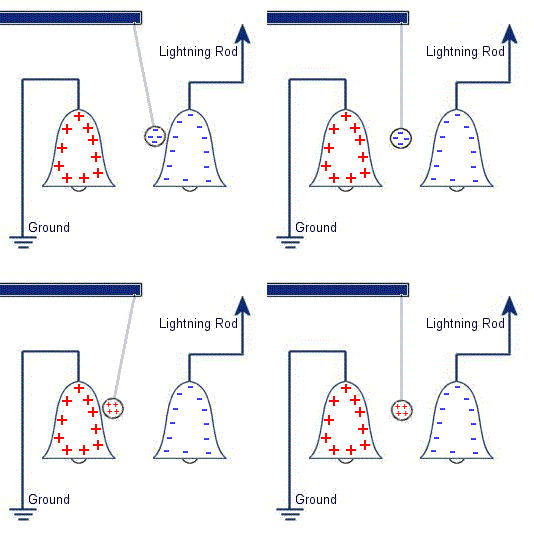 This setup was used by Franklin to collect electric charge for use in other experiments. The amount of charge collected was sometimes so faint that after a spark between the bells it would take considerable time to charge up again. At other times a continuous stream of sparks could be obtained even at lengths of around 20cm.
These sparks could very dangerous and a direct strike to the lightning rod could cause explosions and fire. A safer version of this experiment is easy to setup by using a simulated lightning rod in the form of a high voltage DC power supply such as a Van De Graff generator or Voltage Multiplier.
If you don’t have some bells available then they can be replaced by any metal object such as a drinks can. This experiment works best if all the conductors are smooth, but a foil coated plastic ball will be ok if another type of lightweight metal ball is not available.


Thanks for your assistance on this matter.
A Van De Graff generator would work, but this would probably be just as cumbersome to carry.
Have a look around using Google for something like “how to make static electricity” and you might come up with something that will be suitable for her.
I should also point out that it would need to be an old style CRT type of television too! A modern LCD or plasma TV would not work.
I appreciate your response, so do you have any other recommendations for a strong DC source if a television is not available? I am looking to have my daughter perfomr this project in her classroom and it will be almost impossible for her to carry a television to school (LOL!).
Thanks Again
No, you need a source of high voltage DC, and a proper ground connection.
If your aluminium pan is placed on the floor, it may just about work for a ground, but it will limit the efficiency of your device.
Hello, I am looking into performing the Franklin’s Bells project that is show on ou site and I had a quick question. As a DC sourse, could I use a 12V/Fire Alarm back up battery as a sourse of DC current? Also could I use a aluminum backing pan as a ground? I am trying to do this witout using a TV as a source. Any information that you can provide would be greatly appreciated.
Hello
I can speak on this post because I just make a lightning detector for photography and SLR cameras.
This very small electronic assembly is very easy to make and costs less than 10 dollars.
It works very well and can shoot lightning even in daylight.
You will find all the details, explanations, schematic and example photos on my website: http://rienquepourlesyeux.free.fr
rienquepourlesyeux.free.fr
Maybe if u held the ground wire, you could get a charge and zap someone… what do you think??? it’s probably a weak enough charge.
Greg,
Any wire is fine. The metal tap would be a tap made from metal like in your kitchen sink.
Rich,
Yes you can build it onto some wood, but i would reccommend insulating any metal from the wood with plastic. A device about the size of some drinks cans is ideal.
RE: Franklin Bells Lightning Detector
Can the Franklin Bells Lightning Detector be built on a piece of plywood ? And what are the optimal demensions for the components. A detailed schematic would be a great help.
What kind of wire is best and what do you mean by metal tap?
nice 1 hour w/foil on tv 4testing very cool i WILL HAVE FUN this summer with storms ……..reach out @ touch some oneType your message here
Yes any high voltage DC source will work.
it is a really good experiment, can you get the same reaction replacing the source(tv) for somethingelse??
Some weight may help, or you can just use unopened cans.
Do you need anything in the cans to keep them from moving?
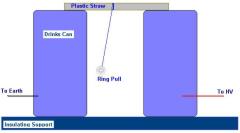
Here’s a diagram of a simple version you can make at home.
Two drinks cans are placed on a plastic tray. One has a wire connected to earth (a radiator or metal tap is fine). The other can has a wire connected to a high voltage, low current source such as a van de graff generator or a piece of foil taped over a TV screen.
A lightweight metal object such as the ringpull from the can is suspended between the cans on a length of cotton. You may need to give it a little push to get it started. If it wont keep moving, then try moving the cans closer together.
the information is great but it would be nice if you could show diagrams