
A Homemade Magnetohydrodynamic Thruster (MHDT)
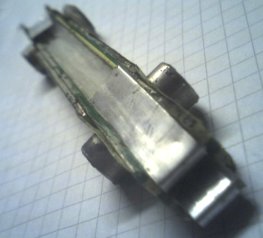 Based on the image on the left, it is possible to make a simple MHD thruster, just powerful enough to propel a toy boat.
This type of thruster generates magnetic fields by passing an electric current through a liquid conductor, such as sea water. Using another magnetic field, the liquid can be pushed in a chosen direction, therefore generating thrust. You can easily make one of these devices from household materials and a couple of neodymium magnets. In the diagram below the small arrows represent the intersecting electric and magnetic fields. the large blue arrow represents the flow of water.
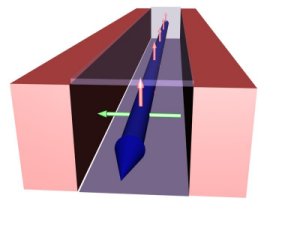 Two opposing inner faces of a rectangular plastic tube are covered by metal strips. These are the main electrodes and should have a connection for a battery. Magnets are attached on the outside of the tube so that they are attracting each other, and are at 90° to the electrodes.
The metal strips here are cut from a thin Aluminium sheet, but you can just use foil although it wont last as long. The electrolysis and salt water corrosion soon eats away at the metal, but foil should last just long enough to see it working. The best sort of electrode would possibly be made from carbon. A good power source for this device would be a pulse width modulated supply such as our power pulse modulator. This would allow you to adjust the frequency and width of electical pulses so that you could get the optimum thrust from your design.
To learn how a MagnetoHydroDynamic thruster works, see the Propulsion section.
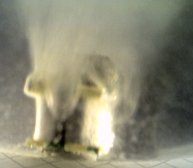 This setup shows the electrodes closer together than the magnets. The combination of magnets used in this device were not strong enough to move the electrified water with any decent force. At only 1.5V in salty water, large amounts of electrolysis occurs, but the water does generally flow in one direction.
The key to getting the best performance it to have the strongest magnetic field you can get across the gap between the electrodes.
Also make sure the magnets are behind the plastic or insulated somehow. You don’t want them shorting out the electric current in the water.


You need to learn about ohms law so that you can understand that your question can’t be answered in the way you are thinking.
Your wire will have a set value of resistance which is determined by its diameter, length, material, and temperature. For this example, lets say that value is 0.1 ohms and we will ignore any variation in temperature etc.
Ohms law states that V = IR (voltage = current times resistance)
If the voltage is 10V, then the the current flowing must be 100 amps because 100 x 0.1 = 10
If you change the voltage, the current will change too. So in your questions A,B,C, to have those values, the wires resistance would be different and it is therefore impossible to have those values on the same piece of wire. A = 1 ohm, B = 100 ohms, C = 10,000 ohms
Question:
Which magnetic field is strongest about say a 1/16″ diameter copper wire four feet long thru which runs 100 watts of juice:
A. 10 volts at 10 amps?
Or
B. 100 volts at 1 amp?
OrÂ
C. 1000 volts at .1 amps?
Thanks,
Tom
Just an idea, suppose I used mercury as the working fluid? I would get enormous current flow, since mercury conducts very well. Making a good contact with the mercury is another matter as it dissolves most metals (iron is immune).
Strikes me that this scheme could make a mercury fountain
hey.i think this will work for my science project.but can you please put the step by step process as well as the materials used in this project?thanks!
The apparent problem with non-linear devices not observing Ohm’s Law is actually false. A non-linear device will vary in resistance as voltage is applied across a junction. Using the measured voltage drop and the current traveling through the device will reveal the junctions resistance. Likewise if you know the resistance of a junction at a certain voltage, the current can be calculated. The current is derived from the Voltage divided by the Resistance in both linear and non-linear devices. If this were not the case then we would probably be about 20 years behind where we are now because each device would have to be built and tested then modified in construction until it is correct because we would not have a law to predict the properties of the circuit. Because many people don’t understand that Ohm’s Law is constantly at work they revert to statements such as the current of the primary side of a non-linear device controls the secondary. Current is the result of Voltage divided by the Resistance. Therefore on a linear device the control is the Voltage. And, on a non-linear device the control is the Voltage drop and determined resistance at the new voltage level. But you need a complete circuit to calculate the parameters. As you work with circuits more, the understanding of how it works will become simple as long as you trace the function of the Law to its root.
Gas can be used too. An ignition coil wont put out much curent though to the magnetic forces would be very small. This type of thruster is known as a Magnetoplasmadynamic Thruster.
Hi!
Didn’t notice this discussion before 🙂
I tried to build one of those “railguns for water”, but it seems like it needs a lot of tinkering to get it to work properly, sort of the same problem as if you make a normal electrical motor but instead of a coil you just have a single wire. I works, but the efficiency is “shit”. I can imagine that if you manage to get several places within the tunnel that conduct, and you get them far enough from each other, so that you end up with separate “conducting areas”, maby you could connect those in series to imitate a sort of coil? hmm.. well, when i think more about it, seems like a coil is a bit different, but … ach, i dont know 🙂
What if you use air instead? Let’s preted we take the ignition coil of a car, a 30 000V capacitor and high voltage diode, something that pulses the coil, end some strong magnets? Then you adjust the air gap between the electrodes so that you get a constant spark. I would do this myself if i had the time and money :-/ (mostly it’s the time that is lacking, it shouldn’t cost a lot to build)
If nothing else you end up with a kick-ass tazer 🙂
I can see the problem though, it would have the same issue as the one with saltwater in it, crappy efficiency. It would just look and sound cooler hehe 🙂
I believe the formula you should look at is : V x A = W Volts times Amps equals Watts… Volts and amps are independent of each other, the combined “power” is rated in “Watts.” If you take a 220 VAC/10 Amp circuit, you have 2200 Watts available to work with. THEN you have them linked and if you step-up the voltage, the amperage is stepped down, when you use the full, available 2200 Watts. However, most power supplies convert only a little more power than the expected demand, say the power supply for a computer, or other electronic device.
Voltage and Amperage can be dealt with as totally independent factors, but used together, they have a measurement we call Watts, which implies the ability to do work(Watts can be converted to other units, such as Horse Power, for direct comparison of the afore mentioned ability to do work).
Brian is on the right track. You cannot use ohm’s law for a circuit as a whole if it has many different components, especially electronic components. I served 8 years in the U.S. Navy as a ship’s electrician and am now an Industrial Electrician working mostly with robotics and magnetic induction melting furnaces (capacitive reactance is wonderful!) In many cases, the higher the voltage, the less current you use. The lower the voltage, the more current you use. But the higher the voltage the more potential for higher currents. Depends on the load application. Also, many, many theories and laws have already been proven wrong. Einstiens theory of relativity: wrong. The whole “speed of light” bullcrap: wrong. Law of gravity: wrong, not even close on that one. Many universities are constantly proving them wrong. U of Wisconsin, Madison is just one off the top of my head. Although, you won’t hear about it in the media. If people knew what Tesla knew, this would be a free world. Most electronic devices, computers, i-phones, etc, resonate at the same high frequency that the human body resonates at, therefore, altering electrical impulses in the brain. Hmm… Don’t sit to close to your tv. lol
You critical approach to my answers is good. This is what makes science work. You should take this same approach with the information in religious texts.
The part you quote is about non-linear electronic components. Such components have semiconductor junctions that change the way electricity flows in them. Salt water is a ‘standard’ linear material and will obey ohms law.
If you had a high voltage, high current source, the spark would be very different to that of a VDG. Air is a dielectric (non-conductor) when the voltage is high enough a phenomenon of avalanche breakdown occurs allowing it to conduct.
Salt water is normally conductive and does not break down in order to allow current to flow. You can test ohms law on salt water yourself very easily.
I said nothing blasphemous. I just presented a series of facts about men, not gods. I don’t need or want forgiveness of any sort from a priest, but I am happy to answer science questions if he emails them to me.
I am still confused about Ohms law if it is simply a law of physics then what does this qoute from Wikipedia mean {from OHM’s LAW}”There are, however, components of electrical circuits which do not obey Ohm’s law; that is, their relationship between current and voltage (their I–V curve) is nonlinear. An example is the p-n junction diode (curve at right). As seen in the figure, the current does not increase linearly with applied voltage for a diode. One can determine a value of current (I) for a given value of applied voltage (V) from the curve, but not from Ohm’s law, since the value of “resistance” is not constant as a function of applied voltage. Further, the current only increases significantly if the applied voltage is positive, not negative. The ratio V/I for some point along the nonlinear curve is sometimes called the static, or chordal, or DC, resistance[15][16], but as seen in the figure the value of total V over total I varies depending on the particular point along the nonlinear curve which is chosen.” Does this not defy the law? Also with a Van De Graf I could have a piece of metal come close to it, and have a spark travel through the air from one conductor to the other. A VDG has high voltage but a small current. I could do the same thing with a high voltage & high current set up (the spark traveling through the air to meet the other piece of metal). They both involve energy moving from one conductor to another, through another conductor(air in this case-which is usually a bad conductor, but with enough high voltage the dielectric of it will brea down). How is this different from energy moving from one conductor to another through salt water? If I can set up an experiement showing two pieces of metal discharging energy through the medium of air with both high and low current-then why is that not possible to do the same thing with salt water(which is a very poor conductor)???? I understand the concept of the magnets now (I was misunderstanding a basic concept, but now I get it) Also My Priest has invented a free energy machine! By using special “traps” he collects units of “bio-energy”. These “bio-energy” units find themselves in a small cage with no where to go but a specialy constructed “hamster wheel”, which they are compelled to turn. The wheel is constructed so that it turns a dynamo. All that is needed is to periodically place bits of vegatable matter into the “cage” and small amounts of water. Also periodic cleaning of dead “bio-energy” units and the setting of traps to capture more “bio-energy” units. He would like your opinion on his device…He says he will forgive your earlier blasphemy & provide you with a promise of eternal salvation at no extra cost for you and (no more than) one other loved one if you send him a research grant into his novel free energy device!
I am certainly correct about ohms law. It is a fundamental law of physics. If you used something like a VDG as the source, the voltage between the electrodes would still be just a few volts because the VDG can’t provide enough current.
When calculating using ohms law you have to include all of the circuit, this includes the power supply. Any power supply has its own internal resistance.
Whatever way you do it, the physics will make ohms law true always.
If you have magnets facing like to like poles, the magnetic field lines will not be at 90 degrees to the electric field. This would cause the water to move in other directions or not at all. It would be quite useless.
You could get stronger fields using electromagnets, but using AC would cause the water to move back and forth, thus giving no net thrust in one direction. If you arranged it so that the magnets also change polarity with the field you could get thrust, but it wouldn’t help. Using AC would also add some impedance to the circuit.
A priest can’t help you. A priest is just a man who claims to represent a god. A god that he can’t communicate with in any way. He is just a man who represents the ideas of other men who use the name of god without any divine authority. If you feel that you committed a “sin” then you have to learn to deal with it your self, try to make up for it in other ways. The only persons advice you may need is that of a lawyer because there are laws to prevent certain experiments from being done. If whatever you do is within the law and does not make you feel like it is immoral or wrong, then it is probably OK.
qouting RMCybernetics Wednesday, 10th June 2009 2:13pm – No.3888—
“Stronger magnets or more current will improve performance equally. Using more current though will heat the water and waste some energy. You should use the strongest magnets possible to improve efficiency.
You can’t increase the voltage without increasing the current and visa-versa. See Ohms Law.
I’ve no idea what you are talking about at the end of your post!”
I am not sure you are entirely right about not being able to raise voltage without raising current. What about something like a Van de Graaff generator being used to power the unit. It creates incredibly high voltage but little current and is an extreme example of what I meant. Why would it not be possible to run this thing in this way? (not neccesarily using a Van De Graff machine) I was always under the impression that current and voltage were different things. Using the anology of water,HV without much current would be like holding your thumb over the end of a water hose. The pressure would be greatly increased yet the actual flow would not. High current yet low current would be like a very wide yet slow moving stream. Another analogy. High voltage yet low current would be like a lead bullet shot out of a gun at high speed. High current, yet low voltage would be like me throwing a very large and heavy lead weight. Both could cause damage, yet in different ways. As for my question about using opposing magnetic fields (N-N, S-S) I think I found the answer to that myself, but please help me to understand if I am wrong. This would either cause the water to not move at all becuase the magnetic field would cancel itself out since it would be moving in opposite directions-OR- it may cause some water to move one way and other to move in the opposite direction dep. on which was closer to which pole. Or am I not understanding that concept??? As for my question at the end of my other post-I have no idea what I was talking about either!
Plus a NEW question-If instead of using magnets you used electromagnets set up in the same way, and from the same power source-and furthermore if this powersource was AC and not DC-then would this not work pretty much the same since both the current and the electromags were run of the same source-they would both(magnets-and electric current)switch polarities at the same time? would this be true of the current moving through the salt water or would there be an increased resistance which would cause a delay which may make the whole thing not work. Assuming it works just fine, however, would it poss. work even better this way, or even perhaps less well. If either would be true please explain why. Also should I ask a priest for forgiveness if I comit a sin against nature-for instance-if I where to create some frankensteinian-unholy-abomination to both nature and man. Would a small hydroelectromagnetic craft be such an abomination, or would I have to resort to science involving a radical reassesment of where life begins and ends, perhaps creating an experiment which redifines such things in such a way as to send shock waves of moral and scientific indignation and disbelief?
Stronger magnets or more current will improve performance equally. Using more current though will heat the water and waste some energy. You should use the strongest magnets possible to improve efficiency.
You can’t increase the voltage without increasing the current and visa-versa. See Ohms Law.
I’ve no idea what you are talking about at the end of your post!
I am wondering if, instead of the magnets set to attract one another they were set to oppose each other. Would this hurt/help the performance or have little to no effect? Also when it comes to the current flowing through the water, what effect does increasing voltage have on the MHD if the current is the same and also vice versa. And to add one last question, which is more important in increasing performance, the power of the magnet or the power of the current? Would increasing one be just as good as increasing the other? Say you cannot increase the power, but you can add stronger magnets? and vice versa….which is more important, or are they pretty much equal? Or should they be as equal as possible for best performance. For instance lets say you increase the power of the current dramatically but are using weak magnets. or vice versa? Also how guilty am I of lying when I claimed I was asking only one more question? Should I seek redemption from a priest, or should I find solace in myself, or vice versa-should I seek solace from a priest and find redemption in myself?
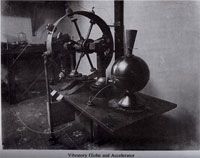
my Magnetohydrodynamic Boat
see it …http://fr.youtube.com/watch?v=sT39rd4P9x4
A magnetic field will deflect charged particles or ions.
Using magnets in your cell would have virtually no effect as the cell overall is neutrally charged (uncharged).
Hello there,
i have been researching HHO generation for a while as a hobby. my aim: to fuel a petrolengine in a car with a mix of 50/50 petrol and HHO. The hho-cell is made of stainless steel plates in tapwater @ 12vAC 10-20 amps. i get about 1 liter/minute of gas production. How about converting the cell to create a “flow” with neodymium magnets would this enhance the electrolysis process and how would it inpact energy consumption?
greetings
I don’t know. You should experiment with different dimensions, you will learn more.
Hi, I have some 1×1/8″ neodymium magnets
I am planning to use for the MHDT. How wide should I make
the tube?
Thanks,
IM
Good quality stainless is non-magnetic
Stainless Steel would tend to block the magnetic field from the gap, I think. The electrodes need to be made of a non-magnetic material such as aluminum or copper. Is this not right?
Stainless steel would still be corroded by electrolysis but at a much lower rate than Aluminium. Ignigting the gas could be quite an interesting mod to the design.
first off, stainless steel is a much better choice for a conductor as is non-corrosive. and secondly, why not take this design a step further and ignite the the Oxy-Hydrogen gas your creating as a by-product of the electrolysis? it could be drawn off and redirected thru stationary thrusters or used to fuel the generator. of course i dont believe the governments of the world are ready to release the truth about water as fuel, but it works.
It will work in any electrically conductive fluid.
Will this propulsion device only work in salt water?
I am thirteen and just wanted to say Thanks for the plans on this i think i am going to make one.
OMG I LOVE U GUYS! YOU JUST SOLVED MY HIGH SCHOOL PROJECT! IM GONNA BEAT ALL MY CLASSMATES IN SCHOOL YAY!
Thats cool! I never knew that something with such a complicated name could be so easy to make.
To the workshop! I’m gonna make myself a Magnetohydrodynamic thruster propelled boat. 🙂