
Magneto Hydrodynamic Thrusters
[ig_row][ig_column span=”span12″][ig_text]
Magneto Hydrodynamic Thrusters
This type of thruster generates magnetic fields by passing an electric current through a liquid conductor, such as sea water. Using another magnetic field, the liquid can be pushed in a chosen direction, therefore generating thrust. You can easily make one of these devices from household materials and a couple of neodymium magnets. In the diagram below the small arrows represent the intersecting electric and magnetic fields. the large blue arrow represents the flow of water.
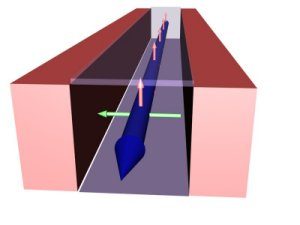 MHD is attractive to engineers because it has no moving parts, which means that a good design might be silent, reliable, efficient and inexpensive. Also known as a caterpillar drive for submarines, this was popularised in the movie The Hunt for Red October as being a “silent drive,” an undetectable stealth super weapon in submarine warfare. In reality, the current travelling through the water would create a great amount of gases, and thus noise.
In the 1990s, Mitsubishi built several prototypes of ships propelled by an MHD system. These ships were only able to reach speeds of 15 km/h despite projections of higher ones;
Japan began sea trials of a prototype magnetic ship. Yamato 1 is propelled by two MHD (magnetohydrodynamic) thrusters that run without any moving parts. When completed, the MHD ship should be able to attain speeds of more than 100 knots (125 miles or 200 kilometers per hour), with little noise. This is several times the top speed of today’s ships, which are slowed down by turbulence created by the ship’s propellers. MHD works by applying a magnetic field to an electrically conducting fluid. The electrically conducting fluid used in the MHD thruster of the Yamoto 1 is seawater.
The major problem with MHD is that with current technologies it is more expensive than a propeller driven by an engine. The extra expense is from the large generator that must be driven by an engine. Such a large generator is not required when an engine directly drives a propeller.
If fuel cells become common, MHD propulsors may have lower costs in some applications than electric motors driving propellers.
A number of experimental methods of spacecraft propulsion are based on magneto hydrodynamic principles. In these the working fluid is usually a plasma or a thin cloud of ions. Some of the techniques include various kinds of ion thruster, the magneto plasma dynamic thruster, and the variable specific impulse magneto plasma rocket.
Info from Wikipedia
Magneto Plasma Dynamic Thruster
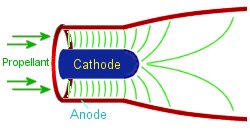 This type of thruster uses electricity as a power source instead of fuel. Although it requires a propellant gas for generating the plasma and transferring momentum. It works on the same principle as the Magneto Hydrodynamic thruster except that the propellant gas is used instead of the seawater.
As the current flows in the gas its magnetic field interacts with the magnetic field produced by current in the cathode and the anode casing. External magnets can be used to further control the plasma.
Although the magnetic interaction accelerates the plasma, thrust is also produced from the rapid expansion of the now hot propellant gasses.
[/ig_text][/ig_column][/ig_row]
14 Comments
Leave a Reply
You must be logged in to post a comment.
Not really. Theoretically you could, but in practice it would be very difficult to make it work. Also electrolysis would be occurring which may be changing the chemical make-up of the water.
Hey, I was wondering if I could use this as a water pump for my fish bowl. I would need it to be able to suck water up from the tank, push it through a filter, and then push it back into the tank. Would it take a large amount of power to do this? (It would be nice to be able to run it on five 9V batteries)
Thanks
It’s hard to answer really.
EHDT’s are incredibly lightweight but also produce very little thrust.
A MHDT will not work with gas as it needs an electrically conductive fluid to work. If the gas is conductive, it is generally a plasma (or partial plasma) and would therefore be a magnetoplasmadynamic thruster. An MPDT needs powerful magnets to work which will make it much heavier, so much so that it would not be able to lift its own weight as a EHDT can.
does magnetohydrodynamic propulsion (when used to propel gas) more efficient than electrohydrodyanic propulsion (aka lifters) in terms of thrust-to-weight ratio? and magentohydro’s power source is alot simpler the elctrohydro, right?
hello !
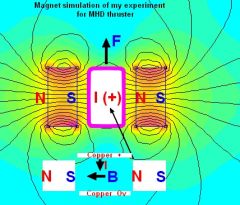
i made several plasma thruster with MHD
see my channel on you tube
http://fr.youtube.com/watch?v=u-S4QHpD0cg&feature=channel_page
or
http://fr.youtube.com/watch?v=9hqN8lmupDo&feature=channel_page
Maybe, it depends how it was set up exactly.
TESLA COIL RELEASES ELECTRIC BOLTS
IT IS PLASMA
IF PLASMA THUS WAS MADE TO FLOW THROUGH AN MHD COIL WOULD ELECTRICITY BE CREATED ?
It’s funny how our biggest battle, is that of our own race. The few of us out there, who REALLY do care about the advancement of man kind and the health of our planet, everyday battle the ticking clock. As a Design Engineer, I’ve personally decided to dedicate my life, contribute, and do my part…towards developing clean energy & propulsions systems. As I see it…this is the real war, so I ask you..did you save a bumble bee today?
Wow fossilman, you make a very good point. It is certainly a different era and politics and economics have always played a role in science. I guess we just have to advance in our sciences as a human race rather than as a nation.
I have made and demonstrated MHD models to students for over 25 years. I have seen worthy magazines like High Frontiers and “Technology Today” from the 70’s morph into something less cutting edge and/or just die out.
The U.S. has lost the cutting edge in many fields because we are too self-satisfied with the status quo of be the “World Power”. Now we are foolishly spending our resources and the resources of future generations on attempting to maintain that position at all costs, rather than using our imaginations and intellect to build a better future. Our heroes have become sports and movie stars rather than Edisons and Wrights. The only thing sports and movie stars can do is take your money.
I agree with the first comment, however, as a student aerospace engineer I see too many projects done by American companies funded by the American government move overseas for cost benefit. The issue is can we as Americans give up paying less for products for quality and community benefit. We are stuck in the ideology of getting more for less; that should be reversed. I believe that many older citizens, especially those from the World Wars, understand this viewpoint and the benefits of hard work.
Take a look at the DIY MHDT project.
You say “You can easily create one using household materials…”
How..?
IMO If we don’t get started building ships or even small personal craft in the very near future using MHDP’s then we as a nation deservr too be left in the past.
For far too long have WE Americans allowed our neighbors in the east to develop new ideas while we collectivly sat on our asses and watched, What happened to our drive to invent, have we become to greedey to care or to fearful to TRY !