
Electric Force
Electric Force
Electric forces act between charged particles or objects. The force is dependent on the amount of charge and the distance between them. Normal matter is often considered to be made from sub atomic (smaller than atoms) particles known as protons, electrons and neutrons. Each particle is said to carry a finite amount of charge. A proton carries a positive charge, an electron carries negative charge, and a neutron carries no charge. The images below are a common way of representing an electric field. The circles with a + or – inside represent charged particles or objects, and the lines are used to represent the field. The closer the lines are to each other, the stronger the electric field.
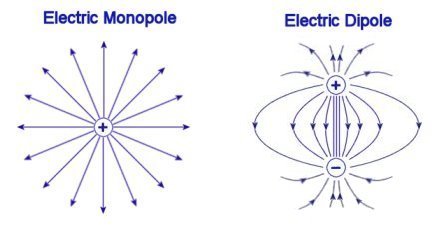 These diagrams give the impression that subatomic particles are like tiny spheres with an exact size. This is not exactly true, but is often easier to treat them as such for simple experiments. An electron is actually more like a fuzzy cloud as it does not really have an exact position. We can never determine the exact location of an electron and this is known as heisenberg’s uncertainty principle. This also explains why the ‘orbiting’ electrons around an atoms positive nucleus don’t come crashing down.
A macroscopic object, such as a metal ball is normally electrically neutral (it contains equal amounts of evenly distributed protons and electrons, i.e., has no net charge). For the object to become charged it must have an excess of either protons or electrons. The difference in the amount of potential energy between the points of a dipole is known as the ‘potential difference’ and is measured in Volts (V). In a solid conductor such as metal, the atoms are fixed in place relative to each other. Some of the outer shell (valence) electrons are free to move between the atoms. If the metal is placed in an electric field, the free electrons will migrate towards the positive end of the field. This movement of charge is known as a current flow and is measured in Amps (I). This current flow gives rise to a magnetic field, which acts perpendicular to the direction of current flow.
Next Page: Magnetic Force
Previous Page: Electromagnetism
7 Comments
Leave a Reply
You must be logged in to post a comment.
Generally you would refer to the Maxwell equations by James Clerk Maxwell.
Who is the scientist that we model our theories on electromagnetism today?
Excellent explanation all we need now is a real life visual to relate to this natural phenomenon!
i found your site useful… but i think the information and illustration are not enough… high school students can’t fully understand this kind of matter. i think ill request that you will reduce the level of learning up to high school students… thanks
I think this intro to electric fields and forces on this page is a clear and well balanced note. Anyone who has studied phys to a basic level (1st year undergrad) should know right away what is meant, and anyone with a passing interest might learn something without being scared away! Good site! Really original + useful and interesting!
Only thing I will say is that more dangerous (and to some more interesting) experiments and DIY projects (the pulse jet for one) should carry a warning note at the bottom; as one thirteen year old seem to have acquired the very dangerous ambition of making himself a pulse jet powered skate board! I really hope someone sensible dissuaded him before he tried!
Thanks for your feedback. I’m not sure I entirley undersand what you are trying to say. Are you saying the information is is at a more basic level than you require? If so is it this topic of ‘Electric Force’ in particular, or do you mean the whole section?
i feel, that the explanation is not sufficient for a junior college student other wise is there any thing excess available in any of our sites.