
Light In Materials
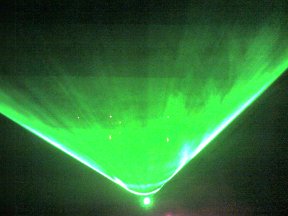 When light passes through a substance such as glass, it is often said to slow down upon entering the glass, and then speed up as it exits. This isn’t exactly true. When an EM wave hits an atom it is absorbed, and the electrons are exited to a higher energy state. The wave is then re-emitted as the electrons fall to a lower state again. The re-emitted photon, or wavelets, phase is slightly behind, relative to the original. This process happens many times over as the wave is passed between the atoms of a material, and has the overall effect of slowing the propagation of the wave. If the incoming wave is vibrating at a similar, but not identical frequency to the atoms natural resonant frequency then the phase shift will be larger.
The majority of materials will retard (slow) the propagation of the wavefront, but plasmas can accelerate it. The wave its self only ever travels at the speed of light (c = 299,792,458 m/s), but the phase velocity can be greater or slower than c.
Next Page: Particles?
Previous Page: Scalar Waves
9 Comments
Leave a Reply
You must be logged in to post a comment.
thanks, he said that it was light’s equivalent of breaking the sound barrier, hence the optical “boom”. i guess that is the speed of light in the medium of the particle.
That’s a good question. The blue glow is a characteristic of Cherenkov radiation. This is light is produced when charged particles pass through a material at a speed that is greater than the speed of light in that material.
The letter c typically refers to the speed of light in a vacuum, but this is the maximum speed of anything at all. In materials like glass or air, the speed of light is slightly less than c. If an incoming particle, usually an electron (beta radiation), is able to move through the material at a grater speed than this (but still less than c), then Cherenkov radiation will be produced.
Speaking of “c” I heard from a nuclear physicists’
friend that when you open up the container that holds the reacted fuel there is a blue “glow”. he says that is radiated particles travelling faster than the speed of light. Whats up with that?
The phase velocity refers to the velocity of a wave of a single frequency of light as it moves through the medium (this represents a beam of light of a single, pure frequency, laser light). The refractive index n=c/v is the ratio of the velocities of photons in a vacuum and in the given medium (v=velocity in medium, c=speed of light in a vacuum). In general, n is not a constant, but depends on the frequency of the photon in question.
Imagine if we had two waves of equal frequency and amplitude moving in opposite directions, the sum of these is a standing wave. This standing wave has nodes, crests and troughs, which do not move their position (the crests & troughs change in amplitude, but their positions in space does not). So although the composite waves are moving, we have a stationary result. The stationary wave has zero Group velocity.
In general, by adding up waves which are all moving with speeds less than c, we can create pulses which move at arbitrary speeds (group velocities). We can even create pulses which travel greater than light speed c! However, this does not violate any physical laws. This is because information cannot be sent faster than the speed of light. This may seem to contradict the previous sentence. However, to send a pulse faster than light speed requires that we first set-up the correct initial light waves across the distance we want to send the message. This takes as long as it would to send a pulse of light at speed c. Making it impossible to send information faster than c!
A good visual illustration of this can be found on the following webpage:
http://gregegan.customer.netspace.net.au/APPLETS/20/20.html
How is the phase velocity different from the velocity of the wave? I’m asking because of the seemingly impossible idea that plasma can allow the wave to travel faster than c.
The behaviour of the light depends on the resonant frequency of the atoms (say, w), the frequency of the incoming light (say, f) and the arrangement of the atoms. Also, the atoms may have more than just two levels, each with it’s own energy and resonant frequency. One way of viewing light is as an oscillating electric and magnetic field passing through space. These fields interact with the ‘charge cloud’ of the electron around the nucleus of the atom, causing it to oscillate. It is when w=f that the cloud resonates most readily, and this maximises the probability that a photon of light will be absorbed, exciting the electron to a higher level.
how does the light propagate in a substance with a resonance frequency(w)? Can you give a equation? Thank you very much.
Ok I’ll answer each question individually.
1. The time the electron remains in a higher state depends upon the amount energy it absorbs from a photon and the atomic structure of the material. The energy of the photon is proportional to its frequency and is calculated as E=hf, where h is planks constant.
The electron falls back to a lower energy state as it is not stable in its ‘excited’ state. Think of how a ball would roll to the lowest point on a smooth surface unles it is held up by another force.
The energy is expended when another photon is emmited from the electron. This photon is of the exact same frequency/energy as the original photon that raised the energy of the electron.
2. The photon is re-emitted so that energy of the elctron is lowered to its previous stable state.
3. A wave is not emitted when the electron is excited because it has to have absorbed one to become excited. Again this is analogous to a ball influenced by gravity. You put energy in to lift it to a higher position, then energy is released again when the ball rolls back down. Consiter the photon as a little packet of energy.
4. The photon emmited from the electron will be of the exact same energy and therfore frequency of the photon which originally raised its energy level. This is because the frequency and energy of the photon are proportional. If the frequency were to change then some energy must be lost or gained elsewhere.
I have got a few basic questions here:
1. How long will the electrons remain in a higher energy state and why will they come back to lower state? Coming to lower state means they loose energy. Where is this energy expended?
2. Why will the wave reemitted when elctrons reach back the lower state?
3. Why is the wave not re emitted when electrons are excited?
4. Is it not more likely explanation that when electrons are hit by the EM wave, they are excited to higher energy level and start emitting photons out of phase with the original wave and at a different frequency so that the wavefront propagation slows down?