
Tesla Coils
Tesla Coils
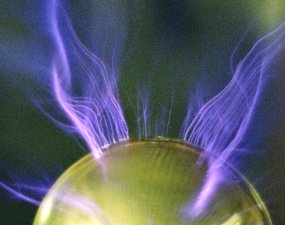 Tesla Coils are air cored resonant transformers. It works by matching all the components in the system so that they resonate at the same (or harmonic) frequency. The end result is that the voltage input is stepped up by a tremendous amount.
Example Tesla Coils
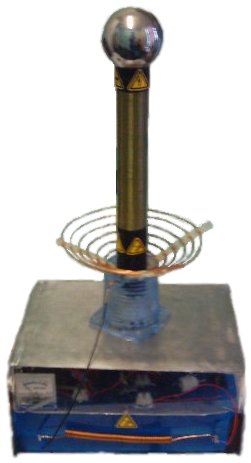
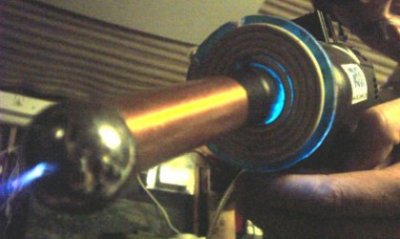 Tesla Coils can come in many forms. These two examples are ones we have made for the DIY Devices section. The image in the right shows a battery powered tesla coil which uses an ignition coil driver to charge the tank capacitor. The leftmost image above shows the ‘Plasma Gun’ which is a much smaller hand held version of the other Tesla Coil shown on the right. Also check out our SRSG Tesla coil rated at 1kW!
How a Tesla Coil Works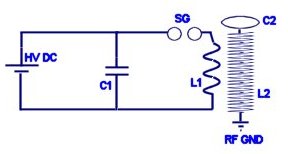
This image shows a simple schematic diagram of a Tesla Coil. There are numerous configurations to choose from. Using this configuration, the TC is powered from a high voltage DC source, such as a rectified output from a neon sign transformer (NST). The device operates in a cyclic manner. This means that a series of changes occur within the circuit, until it is reset and the next cycle begins.
First of all, the capacitor (C1) is charged by the power source (HVDC). When the voltage across the capacitor is high enough, the air in the spark gap (SG) breaks down and allows a current to flow. This forms an LRC (inductance/resistance/capacitance) resonant circuit until the voltage across the capacitor drops sufficiently to quench the spark gap. This all takes a fraction of a second and completes one cycle. The capacitor will then begin charging again. But what about the rest of the circuit? First of all we must understand more about the LRC circuit described above.
When the air in the spark gap breaks down, it is acting like a switch connecting the charged capacitor in parallel with the inductor or coil (L1). As the initial current flows around the LC circuit, energy from C1 is stored in a magnetic field created by L1. When the capacitor is discharged, the magnetic field will collapse. This collapsing field will cause a current to flow in the opposite direction as before, therefore recharging the capacitor. This process will then repeat, causing the current to oscillate back and forth until the energy is dissipated by losses in the circuit and the spark gap quenches. This cycle happens within the other cycle described before, i.e. every time the spark gap fires (1st cycle) the current will oscillate back and forth between C1 and L1 (2nd cycle). The frequency at which the 2nd cycle oscillates is determined by the physical values of the components. This is known as the resonant frequency. The second part of the circuit (C2 and L2) must be constructed so that its natural resonant frequency is the same as the previous part.
A Brief History of Nikola Tesla and the Tesla Coil
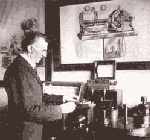 The Tesla Coil (TC) was invented in 1891 by Nikola Tesla. It is one of many ingenious devices he created which have paved the way in which our technology has developed. The AC electrical grid, radio transmitters and car ignition systems we use today are derived directly from Tesla’s inventions. So why have most people never heard of him? History seems to record two different versions of Tesla. One is that he was a crackpot inventor and that he made unsubstantiated claims of fantastical inventions, whereas the other version is of an under appreciated, misunderstood genius. It is the former that seems to be the official view, although it now seems as if the true Nikola Tesla was a combination of both these opinions.
Nikola Tesla was born in Smiljan, Croatia in 1856. As a small boy, Tesla had a problem where certain things could trigger visual memories and they would appear to him as if they were real. These images could persist, therefore obscuring his true vision. He learned to control these images before he matured, and could use this ‘gift’ to his advantage.
He had an extraordinary photographic memory, which allowed him to easily learn six languages. He used his visualization skills like we use a CAD program today. He states in his autobiography that he was able to construct machines, test their performance, and disassemble them to check for ware; All in his mind!
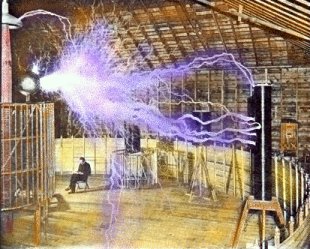
Rotating magnetic fields and resonance fascinated Tesla. He often worked continually on his inventions and theories, only sleeping for two hours per day. Tesla always eat alone and would feel the need to measure exactly the amount of food he was about to consume. He was also obsessed with germs, and avoided touching utensils directly. It is this obsessive behavior gave people an impression that he was a ‘crackpot’. It could also have led to his mental decline in his later years.In his days of invention, Tesla came up with some astonishing ideas and devices. Often he was misunderstood by the rest of the scientific community, as is ideas were so far out from anything that they understood themselves. Tesla made claims that he could transfer energy around the globe without the use of wires, and that the energy its self could be obtained freely from the environment without the need for fuel. These ideas made him unpopular with the establishment, as such devices would reduce their political power and overall wealth. It is only more recently that some of this work is being taken seriously. There is much conspiracy theory around these subjects, but it will not be discussed here. You can learn more about the science involved by going to the physics section of this site. It is also recommended that you do further reading on Nikola Tesla if you are interested in this subject.
Nikola Tesla’s invention of AC electricity is what is used to power homes today yet many people connect the name Edison with electricity’s origins. Both Tesla and Edison were competing with each other for the promotion of their ideas as the best technology. Edison was trying to promote DC electricity as the best way to power homes and went to some extreme lengths in an attempt to discredit Tesla’s work in order to make his own appear superior. The video shown below was filmed in 1903 when Edison electrocuted to death an elephant as a cruel stunt to try to show the danger of AC electricity.
The fact is that Tesla’s AC electricity is actually safer in many ways. Edison just made the current very large. Such large currents would kill regardless of AC or DC. Most of us learned about Edison at school but rarely is it mentioned what a cruel and dishonerable man he was. Tesla sought to make the world better for all, Edison sought wealth and power. Unfortunately money usually wins more power to change things than good will does.
How to Make a Tesla Coil
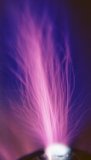 The photo on the left shows electrical discharge through a small flame on the top sphere of a homemade, battery powered Tesla Coil. The aim of this design was to get the highest voltage (or longest arcs) possible from a singe self contained unit. This coil operates from 12V or 24V SLA batteries. A pair of car ignition coils are used to provide around 20kV for charging the capacitor bank. The ignition coils are driven by a variable frequency square wave from a 555 timing chip and four large transistors (2N3055).
More Info: DIY Homemade Tesla Coil
54 Comments
Leave a Reply
You must be logged in to post a comment.
Allan,
It sounds to me like you are not getting enough feedback from your coil. You could have a too short antenna. Also, Check to make sure that your startup oscillator is at least running around 1/2 of the coils resonant frequency. The only other problem I could think of is if your voltage regulator has somehow failed.
I have built a clone of steve wards micro sstc. It has been working for a while but now it only works for a second upon startup or doesn’t even oscillate. (the gate drive signal is staying at the startup oscillator frez.)
You can do this, but you must not connect the earth connection to the transformers. This would also mean that the metal body (if it has one) or any other normally earthed points are now at high voltage and should not be touched.
I’m going to purchase two (2) 15kV, 30mA NST’s for making my own Tesla Coil. I was hoping to link them together in series (to make one 30kV, 30mA tranformer). I was wondering if this would be damaging at all to either the transformers, or the power supply (120VAC wall socket supply). I was thinking that it might be damaging if the series tries to send power back into the wall socket; or would the series only take place inside of the transformer? Thanks!
If you are only using a single diode then one of your coils is being wasted when in the reverse parallel arrangement. Use full wave or just connect them in parallel.
The 2500pF is likely to be making your circuit have the correct resonant frequency. Tuning a small TC is often quite difficult.
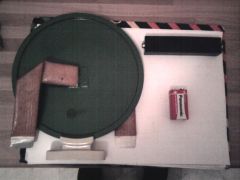
oh yes i forgot to mention my diode,im only using one at the moment becouse thats all i have its in the top right of the picture attachment,9v battery for size comparison,not that it matters,its a 40kv 1 amp diode. do you think full wave rectfication would out perform half wave? also i have a new capacitor in the left of the picture,its a rather large ceramic disc type,5kv @ 2500pf.although this is only a 5th the rated voltage of my mmc that i mentioned it seems to work better as i can draw around 90mm streamers from my toroid and see lots of purple sparks on the end of a screwdriver around 12 inches from the tesla coil.i feel the coil has more to give if i can get the power there,i have 3 of these capacitors but if i connect them together in series or paralell it seems to make the streamers weak or dissapear alltogether.i think maybe the 2500pf value is close to optimum for my tc but maybe with more volts?
You don’t mention any diodes. You will need HV diodes on the output of your coils to properly charge the cap bank.
hi there im having trouble biulding an mmc for my tesla coil project,im using 2 car ignition coils powered by a 12v battery and a square wave generator.the coils are wired in reverse paralell so that one is hv out and the other is used for hv ground.i have biult an mmc with some 4kv 3300pf caps. i have 7 stings of 7 to get 28kv at 3300pf with 10m ohm bleed resistors between each one as a starting point,my problem is that its not very powerfull, if i take just 3 of these caps wired in series with no resistors and try them on my rig it seems that there is a bigger and noisier spark at the gap leading me to think that there is more energy available here than in my mmc with the 7 strings of 7.are the resistors using up some of the energy or are the caps just not up to the job? i have 220 of these to play with so i can biuld bigger if neccesary.this is my first coil so any help would be apreciated.thankyou..
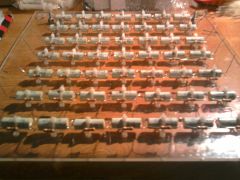
Not really. The unit is a voltage multiplier circuit.
Can one make a tesla coil from an ionic breeze unit? I have an old one and wondering if it contains a tesla coil already?
I guess so, but it would be a bit inpractical. Its ability to incinirate would be proportional to the input power. This means you would need huge power supply systems.
Happy Birthday to Dr Tesla
can tesla coils really be used a weapon to incinerate things?
The hiddink capacitor is a HV DC device whereas the TC is AC. I suspect they would not work well together.
will the performance of the teslacoil be improved if a joseph hiddink capaciter is added near the top load
Yes it would discharge, but that sounds very dangerous. I do not reccomend that.
It is better to solder a bleeder resistor between the capacitor terminals. This would be a very high ohm resistor that would slowly discharge the capacitor.
can i discharge a HV capacitor (sumthing like microwave oven ones) by throwing it to water? (i h8 sparks)
Yes that is basically all that is needed.
People take apart an NST so that they can seperate the center tapping of the windings from the ground. This allows the full AC voltage to be used. Without doing this, you capacitors will only charge when connected between the ground and one of the output therefore giving only half the transformers voltage rating.
I have purchased a 9000 volt 30 ma neon sign transformer for building a Tesla Coil and had a few questions for you fine folks. I know my capacitors need to be at least double the output voltage of the transformer and they need to be approx. 13-15nf. I want to build a very simple design, but I have noticed so many designs out there that it seems a bit overwhelming. Can I put a Tesla Coil together using just: variac, NST, spark gap, caps,primary and secondary? (of course all extra basic necessities involved). Also, I noticed a lot of folks pull the tar from the transformers…why? Thanks!
You can do it like that or place one accross the whole thing. It is generally safer to put one accross each capacitor.
For my tesla coil tank capacitor, I would probably want a bleeder resistor across every capacitor, right? They are all in series, so this sounds right.
I think that varying the capacitor charging current would be the most efective way. That would be simple to implement on a TC like this one. The downside is that the fidelity of the sound would be very poor. I doubt you would be able to produce recognisable speech. The problem is that break rate of the spark gab determines the nyquist frequency fo the sound you can use. I think the break rate would be in the range of hundreds of Hz meaning that any sounds in the kHz range would be lost. An SSTC offers the advantage of being able to switch at very high rates while remaining at highpower.
Singing/ musical tesla coils are a lot of fun, but all seem to be SSTCs, which are complex and expensive. Would it be possible to make a spark gap TC, fixed or rotary, that could also produce music by varying the spark rate (by varying the speed of a rotary gap), or varying the power fed to the capacitor (so that it charges more quickly/ slowly)?
Anyone who wants to see a singing TC in action need only head over to Youtube.
sir, i’m studnt now.. can i know what type of software you use to simulate the circuit of tesla coil and how can i get and learn more about tesla coil.
Yes
Type your message here
can an tesla coil attract lightning bolts ?
–/ DR TESLA CLAIMED THAT HE COULD SEND ELECTRICITY WIRELESSLY . USING THE THEN TECHNOLOGY HOW COULD THIS BE POSSIBLE ? . CAN THIS BE POSSIBLE TODAY?
————/ HOW DOES THE MORAY GENERATOR WORK ? , IS IT SIMILAR OR BETTERTHAN COLONEL DR TOM BEARDEN’S M.E.G GNERATOR.
No. High power high voltage systems combined with ionizing laser beams have been used for entrance denial systems, but they are not going to look or function like the things from Red Alert
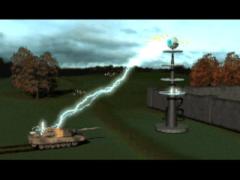
THIS IS A DESCRIPTION OF- A TESLACOIL BASE DEFENCE WEAPON- FROM RED ALERT 2
The structure was shaped like a Christmas tree with a Van de Graaff generator at the top. Electrical arcs would travel up the structure and energize the generator, which launched powerful bolts of electricity for a considerable distance, potentially delivering 3 bolts of electricity with a single charge-up, depending on the number of enemies who were present in the area – obviously, additional charges would not be used on already destroyed enemies. Based on the unit’s appearance, it seems as if the unit was acting as a giant staggered capacitor which is released by a maser-activated air ionizer, delivering power in massive surges to the generator ball at the top. Another Maser, more powerful, flash ionizes the air between the top collector and the target, and the simultaneous discharge travels through the air to the target, incinerating it. Tesla troopers who fired upon a Tesla coil would not damage it – instead, they would power it up, supercharging it under regular conditions and keeping it powered under low-power conditions. A supercharged Tesla coil had even greater range and power than a regular Tesla coil.
WILL THIS COMBINATION WORK IN REAL LIFE ?
Placing them in parallel will add he current output together, not voltage.
The only real protection you can have is not touching it. This gets difficult as when building it you would often run it and then make adjustments. You should make sure your capcitors have bleeder resistors so that they wont stay charged and physically disconnect the TC from mains before you go near it.
Proper grounding of various parts and controls is essential. If somehting fails it is possible for things to float at a very high voltage without you realising. You don’t even have to touch and a spark can jump out and kill instantly.
If it is your 1st TC I really think you should not use MOT’s. Use an NST as the current limiting helps keep it safer and is less likley to damage your components.
You shouldnt get near enough to need a faraday cage when it is running. THe age would also effect the tuning an operation of the coil.
Hi there, I am going to build my first TC fairly soon and I want to make it Solid State, however I’ve heard and read about all the problems people tend to have with cooling the MOSFETs, transistors so I was thinking being really old school and using some vacuum tubes; further I have heard that Neon Sign Transformers make easy HVAC power supplies but they are current limited… so I have around 10 or so Microwave Oven Transformers rated at 3kV (I think). I’ve dealt with high current (250A+) at high voltages but I have a nagging feeling that with around 30kV from running the MOTs in parrallel (you can do that right?) the current could be well over anything I have ever dealt with would a faraday cage around the TC provide adequite protection?
Tesla was a genius whose ideas were stolen by the “money changers” and released at optimal time for maximum profit. To keep anyone from pointing out that Tesla was the genius behind all of it they bankrupted him then discredited him so that anyone who cites him would be considered a kook in the “established” order of things.
Look at simple things like the Ionic Breeze from Sharper Image, Cell Phones, RF toys etc.. All were the brainchild of Tesla yet there were too many ideas too quickly to make any sort of profit from. Think of how big pharma operates now, they stockpile patents then release products creating a pipeline of viability for maximum profits. The FDA testing times vs. patent expirations defines their throughput. The “money changers” run the show and will only allow us to have what they think we are able to handle so that society does not buck their authority and control.
Email us for those details. Nice coil!
What city and country are you located in?
direct tel number?
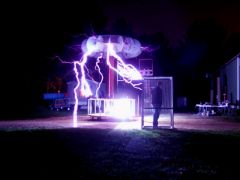
Attached is photo of my large Tesla coil.
D.C. Cox
EPX101,
Yes.
The N3RD,
The sound level is roughly proportional to the power you put into it. This Tesla Coil produced a noise level akin to that of a blender (food processor).
My friend was just about to start constructing his tesla coil, when he changed his mind because of the noise factor. How loud are they (I’m talking about one 2 feet or less in height)? Can you compare them to something? Thanks
can i use a NAND gate pulse generator instead of a 555 timer???
Sounds ok. You should always use components rated for much more voltage then you intend to apply to them.
Type your message here
can you use a 35kvdc, .o30uF capacitor with a 12kv neon transformer. The previous cap was a 15kvacw with a 15 kv transformer and worked well for a while then blew.
No, DC input coils are probably less common. There are many ways you can make a Tesla coil.
The coils on this site use DC because the ignition coils used for the HV source will not charge a capacitor in the same way as a mains powered transformer.
A mains powered transformer is driven by a sine wave and with enough current that it can charge a tank capacitor on each half cycle.
does the power supply have to be DC? because there are a whole bunch of sites that dont say any thing about DC. they just connect it directly to the transformer and it seems to work
The way they work is described on this page and more info can be found by following links from this page or by just searching on Google.
The ball is not a Van De Graff generator ball but it serves a similar purpose. It acts as a small reservoir for electrical energy and it also helps control the way the arcs are formed. The ball is referred to as a ‘topload’ and it can be any shaped piece of metal but smooth round shapes work best.
I HAVE SEEN TESLACOIL’S IN RED ALERT AND RED ALERT2 HOW DO THEY WORK? AND WHY DO THEY NEED VAN DE GRAFGENERATOR BALL ?
i think tesla got so much imagination that he imagined how many people touched utensils at the restaurant
and he also imagine thew germs going through his arms NO OFFENSE
Tesla would not like to touch utensils when he was sitting in a restaurant with no high voltage devices around. It seems he suffered from a form of obsessive compulsive disorder based on the relativley new concept of germs and bacteria.
I think tesla dont wanna touch utensils because if the tesla coil is on high voltage can e produced in the metal tool he would be using he is just being safe
How about the Ignition Coil Driver page.
The frequency depends on your coil and its load so I can’t really answer your question. A variable frequency source is often used so it can be tweaked until the best output is found.
I’m sorry if this is the wrong category for this question. I’m not sure which one it would fit under
What would be a good frequency to run my ignition coil?
Thank you very much.
A basic Tesla coil consists of two separate LC (inductor, capacitor) circuits which are not electrically connected but are loosely coupled electromagnetically. Any LC circuit has a natural resonant frequency at which it ‘prefers’ to oscillate. For efficient energy transfer both LC circuits of a TC must be the same.
You can measure the frequency of an LC circuit by connecting it to the scope and applying an electrical pulse. This pulse should set the circuit ringing and you should be able to see the result on your scope.
The primary circuit is a parallel LC circuit which will give maximum reactance at it resonant frequency. The secondary coil and topload form a series LC circuit which will give minimum reactance at the resonant frequency.
If you apply a signal source across an LC circuit, you can measure the high and low points while adjusting the frequency of your source. At the resonant frequency of your LC circuit the voltage measured on the scope will be either higher or lower than at other frequencies depending upon if it is series or parallel LC.
If you know the frequency of the secondary circuit, you can set a signal generator to match this and apply it to the primary LC circuit. You can then adjust your tapping point on the primary coil until you see the signal on your scope at its maximum level.
Thanks for providing such a wonderful service. Could you outline in detail, the method (if there is one) of tuning a tesla coil with an oscilliscope, or point me in the right direction? I’ve spent several days on your website and have not run across it. The quality of your replies is the best I have found on the net thus far, great work. Steve
Weather or not the AC power gets in to the output arc you do not want to be toucing them EVER!
It can be ‘safer’ to run a TC from batteries, but it could still quite easily kill you. Any device that charges capacitors to high voltage can be instantly lethal.
This mini Tesla Coil runs from a small 12V battery. Internally there are still capacitors being charged to thousands of volts so touching the wrong part could be nasty. A bleeder resistor is usually placed across the tank capacitor so that it wont hold charge for very long after being switched off.
I am hoping to make a tesla coil, but I had heard that it is dangerous because it can spark to you and spark to the AC power supply creating a ionized trail in the air so that the 110v AC can zap you, so is it safe if you use batteries?
Are there any safety issues? If so what are they?
Thanks for your help.
Yes, it will work if the polarities are correct, and the output voltage of transformers are the same.
I have 4 neon transformers i would like to hook the transformers up in parallel, the transformers are 9000 volt at 30 milamps this should give me 120 milamps will this work im going to run wires to the first transformer to power it then connect the primaries of the other transformers to the first transformer, then connect the secondaries together to give me 120 ma?