
Unexplained Phenomenon
There are thousands of events occurring around us every day that remain unexplained. From complex phenomenon in physics to such common occurrences such as lightning. This page covers a few of the interesting subjects, and allows you to add your suggestions or possible explanations below.
The Hutchison Effect
John Hutchison is a Canadian who accidentally discovered some highly unusual physical phenomenon. The unexplained phenomenon known as the Hutchison effect is actually a series of different effects from different experiments. He was able to levitate objects, liquefy metals at room temperature, and merge materials together. These effects were created by combining high gradient fields from Tesla coils and electrostatic machines such as Van De Graff generators. His own apartment was crammed full of old equipment that he had salvaged from Navy ships. Hutchison is not a not a qualified scientist, and performed his experiments purely out of interest. This lack of standard scientific education is probably what enabled him to make his discoveries, because the set up he used did not make any sense to standard science and the effects were supposedly impossible. The effects he produced have now been termed ‘the Hutchison effect’, but there is still little explanation for what exactly they are. Hutchison’s experiments were performed quite randomly, with little more than intuition to guide him. This sort of experimenting can be highly dangerous and should not be attempted by amateurs.
v Blaze Labs Article v
We know that the state of matter can be changed from one to the other of the four states in the order: Solid – Liquid – Gas – Plasma, by means of increasing or decreasing external energy supplied to the structure. The most common example is water, which when heated changes from liquid to gas and when cooled changes into a solid block of ice. But heating and cooling are just the most inefficient ways to change the state of matter. The state of matter shift occurring with the change of temperature, seems to be only a by-product of the heating, which means that only a part of the energy accumulated in the system is used on weakening the molecular bonds, the most of it going to Brownian kinetic energy in atoms and molecules as large bodies. Therefore, finding the resonance frequency (or harmonics) of the molecular bonds would be indeed a much more efficient way of changing the state of matter.
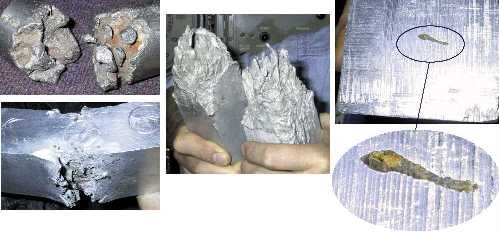
The Hutchison Effect is a collection of phenomena which were discovered accidentally by John Hutchison during attempts to study the longitudinal waves of Tesla back in 1979. The Hutchison Effect occurs as the result of radio wave interferences in a 3 dimensional zone space volume radiated by two or more high voltage sources, usually a Van de Graff generator, and two or more Tesla coils. The results are levitation of heavy objects, fusion of dissimilar materials such as metal and wood (as shown in the upper right corner of the photo), the anomalous melting (without heating) of metals without burning adjacent material, spontaneous fracturing of metals (which separate by sliding in a sideways fashion), and both temporary and permanent changes in the crystalline structure and physical properties of metals as shown above. The fusion of dissimilar materials, which is exceedingly remarkable, indicates clearly that the Hutchison Effect has a powerful influence on intermolecular forces. Dissimilar substances such as steel and copper or wood can simply “come together,” yet the individual substances do not dissociate. A block of wood can simply “sink into” a metal bar, yet neither the metal bar nor the block of wood come apart or carbonise. On the lower left corner of the photo, you may see the imprint left over by coins which were sitting on top of the steel bar during the effect.
The anomalous melting of metal without any evidence of heating, burning or scorching of the adjacent materials (usually wood) can be easily explained if one considers the external high voltage intermediate frequency source to be resonant with the molecular structure of the metal. In such a case, resonance will efficiently use up the external energy to change the metal structure, to the next higher energy level structure which is the liquid state. Thus the metal structure will take over liquid properties, and any foreign solid material, such as wood or different metal, will ‘sink’ into it. Once the oscillation is switched off, the foreign material will be permanently trapped within the solid structure. The radio wave interferences involved in producing these effects are produced from at least two radio sources, with the correct frequency difference, both operating at low power. However, the zone in which the interferences take place is stressed by hundreds of kilovolts oscillating at the intermediate resonant frequency.
^ Blaze Labs Article ^
Unsolved problems in physics
There’s a lot of unexplained phenomenon in science. Here you can find a list of just a few of them. If you have your own, or have ideas about any of them, please leave a message at the bottom of the page. Often it is the Unexplained phenomenon that makes science so interesting!
This is an incomplete list of some of the unsolved problems in physics. Some of these problems are theoretical, meaning that existing theories seem incapable of explaining some observed phenomenon or experimental result. Others are experimental, meaning that there is a difficulty in creating an experiment to test a proposed theory or investigate a phenomenon in greater detail.

Got an answer to any of these unsolved problems? Leave a message below.
Accretion disc jets: Why do the accretion discs surrounding certain astronomical objects, such as the nuclei of active galaxies, emit relativistic jets along their polar axes?
Accelerating universe: Why is the expansion of the universe accelerating, as we have observed? What is the nature of the dark energy driving this acceleration? If it is due to a cosmological constant, why is the constant so small, yet non-zero? Why isn’t it huge, as predicted by most quantum field theories, or zero for some yet unknown symmetry reason? What is the ultimate fate of the universe?
Amorphous solids: What is the nature of the transition between a fluid or regular solid and a glassy phase? What are the physical processes giving rise to the general properties of glasses?
Arrow of time: Why did the universe have such low entropy in the past, resulting in the distinction between past and future and the second law of thermodynamics?
Baryon asymmetry: Why is there far more matter than antimatter in the universe?
Cosmic inflation: Is the theory of cosmic inflation correct, and if so, what are the details of this epoch? What is the hypothetical inflaton field giving rise to inflation?
Dark matter: What is the nature of the material observed via only its gravitational effects (for example, in the Galaxy rotation problem)? Or, does such matter exist at all? (An alternate explanation could be that the equations of General Relativity are subtly wrong, for example in Modified Newtonian Dynamics).
Fusion power: Is it possible to construct a practical nuclear reactor that is powered by nuclear fusion rather than nuclear fission?
Gamma ray bursts: What is the nature of these extraordinarily energetic astronomical objects?
Gravitational waves: Is our universe filled with gravitational radiation from the big bang? From astrophysical sources, such as inspiralling neutron stars? What can this tell us about quantum gravity and general relativity?
GZK paradox: Why is it that some cosmic rays appear to possess energies that are impossibly high, given that there are no sufficiently energetic cosmic ray sources near the Earth, and cosmic rays emitted by distant sources should have been absorbed by the cosmic microwave background radiation?
High-temperature superconductors: Why do certain materials exhibit superconductivity at temperatures much higher than around 50 kelvins?
Magnetic monopoles: Are there any particles that carry “magnetic charge”, and if so, why are they so difficult to detect?
Pioneer anomaly: What causes the apparent residual Sunward acceleration of the Pioneer spacecraft?
Proton decay: Do protons decay? If so, then what is their half-life?
Quantum chromodynamics (QCD) in the non-perturbative regime: The equations of QCD remain unsolved at energy scales relevant for describing atomic nuclei. How does QCD give rise to the physics of nuclei and nuclear constituents?
Quantum computers: Is it possible to construct a practical computer that performs calculations on qubits (quantum bits)?
Quantum gravity: How can the theory of quantum mechanics be merged with the theory of general relativity to produce a so-called “theory of everything”? Does our present understanding of the gravitational force remain correct at microscopic length scales? What verifiable predictions does any theory of quantum gravity make?
Quantum mechanics in the correspondence limit: Is there a preferred interpretation of quantum mechanics? How does the quantum description of reality, which includes elements such as the superposition of states and wavefunction collapse, give rise to the reality we perceive?
Standard Model parameters: What gives rise to the Standard Model of particle physics? Why do its particle masses and coupling constants possess the values we have measured? Does the Higgs boson predicted by the model really exist? Why are there 3 classes of particles in the Standard Model? Is the Standard Model reality, a good approximation to reality or fatally flawed?
String theory: Is string theory, or superstring theory, or M-theory, or some other variant on this theme, the final “theory of everything”, a step on the road or a blind alley?
Supersymmetry: Is supersymmetry a symmetry of Nature? If so, how is supersymmetry broken, and why? Can the new particles predicted by supersymmetry be detected?
Turbulence: Is it possible to make a theoretical model to describe the behavior of a turbulent fluid (in particular, its internal structures)?
Next Page: Figures & Formulae
Previous Page: Astrophysics & Space Phenomenon
17 Comments
Leave a Reply
You must be logged in to post a comment.
Pipe down, Jim Jones. Nobody wants to join your Peoples Temple.

If you are really interested. Then you will have to forget this establishment’s science. full stop.
Find out more for yourself about Keylontic Science.
Maybe it will solve some of the questions and supply the true answers.
Because in reality everything is only a holographic projection by " YOU ".
Black holes: What started out as a mathematical non reducible mathematical artefact, could be proven to exist. A naked singularity is very hard to detect: it could be detected by light bending of stars which was not there before. The presence of such singularities is more likely with large clusters of mass where it would have a definite effect on nearby stars, ripping it clean of its mass and emitting very high burst of energy rays.
Baryon asymmetry:
Mass is a form of energy confined to its own space. E=mc2, that is hardly anything new.E, energy, is the norm |Re(phi)|of the real part of the wave function, effective the square of the amplitude of the wave packet. So E will be a positive entity always (as observed by us) E=mc2 written as E/c2 = m, is also always a positive entity as c2 is positive always also. So what do we call anti particles? Those particles with opposite charge. But charge is another dimension, independent of time-space. In case the energy is already present, as in particle experiments, its possible charge is already accounted for in the ‘charge’ dimension, all the kinetic energy will be distributed in a shower of elementary particles with the charges evenly distributed over all particles which do exist. On the charge dimension nothing changes 0 charge before stays 0 charge afterwards, +2 stays +2 afterwards, after all in between particles have decayed.
If we imagine the charge dimension as a circular axis with its geometric center slightly off at the 0 point of 4D space so that the – charge is slightly closer to the center, so that negative charge would ‘stick’ with a preference to a light energy particle like an electron and + charge to a heavier element like a proton. The displacement of that charge dimension centre is likely to be given by the amount of energy available in the collision. Large energy: smack in the middle. Minimal energy, very close to the neutral side (neutrino’s, with the ability to change ‘color’, flipping to both sides), average (whatever, enough for a neutron to create, it will decay in 8 minutes of time) both charges rolled in one. Below average, Gamma-rays which may interfere to gain enough for a positron/electron pair.
Answer to one of the questions (Big word, possible answer/solution better expression) regarding ever accelerating universe (Q2). Answer might also be a solution to a number of other questions.
Every point in space is able to emit 2n photons (n =1 and up, travelling wave packets) with a certain minimum energy in all directions. What energy is possible is mainly determined by the surrounding mass of that space. Those wave packets can interfere with each other producing a standing wave packet, limited to space, in the form of an elementary particle, stable in time or not. As it seems only electrons and protons are stable enough to survive a couple of billion years.
Just as the photons can interfere to form particles, particles can interfere to form blobs in space as a kernel for the existence of galaxy systems. Just as with the Casimir effect that less radiation pressure in between the plates will force the plates together. In the end the galaxies will collect so much mass that at certain points solar systems will ignite, possible collapsing into a black hole in which the mass will slowly disappear (evaporate) into oblivion, just as it did appear in first instance. Energy balance is restored (final).
That constant popping into existence of photons will provide an inward pressure on areas which do have a bit of mass collected. Pressure is nothing else as a force, which causes acceleration on mass. So there will be a tendency that all clusters of mass will be tightly compressed and accelerate away from each other. Furthermore the constant creation of energy in that ‘vacuum’, the ‘remains of not interacted photons is getting to us as the amazingly constant everywhere cosmic background radiation.
In classical physic universe should than be a uniform distributed amount of mass everywhere with some statistical reasonable lumps of mass here and there, not this scattered grapefruit’s and speckles. Just as the Casimir effect is based on the uncertainty principle or zero-point energy principle there is a uncertainty in position and energy content
we need many more cycles of evolution to truly understand what our reality is made of. or maybe our creators will “upgrade” our brain again for us to see the unseen. Until then we need to resolve more urgent problems our race is confronting with now.
Type your message here Could you give me more information about the pioneer anomaly, I think i have a theory that might explain what i have read, but all i have read is that they aren’t going as fast as predicted, and need a bit more info. Such as if it emerged from acceleration on time, or ahead or behind the expected time. Full details would be appreciated, the theory may also explain why universe seems to be expanding.
HOW DOES THE MORAY GENERATOR WORK
IS IT DIFFERENT OR SIMILAR TO COLONEL DR TOM BEARDEN,S MEG GENERATOR
WHAT IS THE THEORY BEHIND IT.
Read our Introduction to Electromagnetism
what is electricity
I think quantum computing is already done. I think the company that made the first one is D-wave.
you crazy, boy
Mr. Hutchson has stumbled on what will be called ” The Gravetron effect ” the problem is that, in the near future it will be used as a deadly weapon. I myself have known about this “Effect wave” for 20 years now. May God help us all.
I think the problem with turbulance is just there aren’t any computers powerful enough to take everything into consideration. If you take pure de-ionized water in a container and swished it around until it formed a vortex then stopped it, you can easily predict the outcome as long as you could measure each molecule and knew wich molecules had any type of foreing matter.
Hi Tylor, I’m not sure I understand your question. In what dimensions is this hole you mention, and what exactly do you mean by a hole?
This article on dimensions may be helpful.
Other Dimensions
If the string theroy is correct then woulden,t there be holes in the dimminsion every time we used an atomic bomb?