
Electric Minerals
Electric Minerals and Natural Electricity
Piezoelectricity
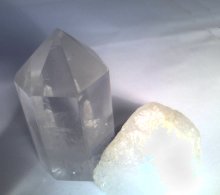 There are many forms of electric minerals. Charge separation between opposite faces of a crystal occurs when it is stressed. This is due to the regular atomic structure within the crystal. The effect also works in reverse, therefore applying a potential difference to the opposing faces will cause the crystal to expand or contract, depending upon the polarity.
The most commonly known piezoelectric material is Quartz (SiO2). Many other important minerals are often found within quartz deposits. Tiny pieces of quartz are used in watches, clocks and radio transceivers to provide a stable and precise frequency for the circuitry. Piezoelectric lighters use a spring loaded hammer to strike a small crystal which will produce a high voltage spark.
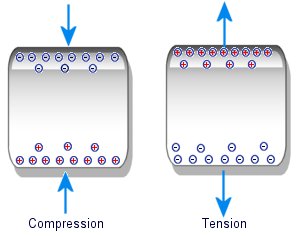
The diagram on the right shows how some of the charge becomes separated in a piezoelectric material when stressed. The effect of applying a voltage to deform the crystal is not always parallel like shown here. The effect depends on the crystal structure and sometimes the deformation can sheer or be at different angles compared to the electric field.
Pyroelectricity
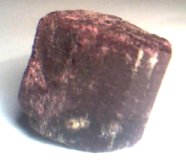 The pyroelectric effect occurs in certain materials when they are uniformly heated or cooled. This effect is directly related to the piezoelectric effect, as the charge separation occurs when the material expands or contracts due to a change in temperature. This effect is non reversible, therefore applying a potential difference to the material will not cause it to change temperature significantly.
Tourmaline is a mineral made from a mixture of substances (Na(Mg,Fe,Li,Al,Mn)3Al6(BO3)3O18(OH,F)4). It is a naturally occurring mineral, which can generate an electric field when it is heated or cooled. Natural crystal formations of Tourmaline can show a variety of colours and forms. Red Tourmaline was discovered to hold electric properties when ash particles were attracted and repelled by pieces in a fire.
Thermoelectricity
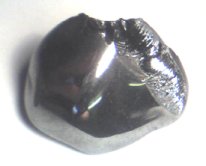 The Thermoelectric effect is used to generate a low voltage rather than a high voltage, as many stages would be required, making it impractical. This effect occurs when the junction of two dissimilar materials is heated. This arrangement is often referred to as a Thermocouple. Using differently doped pieces of silicon it is possible to produce a device known as a Peltier heat pump.
This effect also works in reverse and is known as the Seebeck or Peltier effect. When a voltage is applied to the junction heat is ‘moved’ in one direction therefore cooling on side and heating the other.
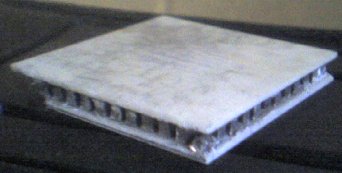 This device allows heat to be moved electronically from one place to another, even against the temperature gradient (from cold to hot). Simply connecting a Peltier device to a DC voltage will cause one side to freeze, whilst the other side heats up. The effectiveness of the pump at moving the heat away from the cold side is totally dependent upon how well you can remove the heat from the hot side. This device can also be used to generate electricity if a temperature difference is maintained between the two sides.
DIY Dehumidifier Using the Thermoelectric Effect
This device utilises the cooling effect of peltier heat pumps in order to extract water from the air. The device was used in a damp basement and could collect about 500ml per day. The erratic wiring in the image make this device appear much more complex than it really is. There are a large number of wires because several different sized heat pumps were used, and each requires a different voltage. The six fans all ran from 12 volts. To provide the various voltages to the device a standard 500W ATX PC power supply was used. This type of PSU can be very useful for various experiments as they can provide a range of voltages simultaneously with a reasonable power output, and they are also overload protected.
Read more in the DIY Devices section
54 Comments
Leave a Reply
You must be logged in to post a comment.
No. The force must be dynamic (changing) for electrical energy to be produced.
What about gravity? If you get a ball of quartz… Oh, let’s say, the size of the moon and then coat it with the something very heavy, wouldn’t it start spewing out electricity forever converting gravitational pull?
Energy can’t be made, only converted from one form to another. The kinetic energy in the rod can be calculated as E = 0.5 x mass x velocity x velocity.
The amount of electrical energy that is available from the crystal will be less than this value due to it not being a 100% eficcient conversion process.
If I had a 500 lb rod that pressed down on a quartz crystal every 5 seconds how much electrical NRG could be made?
St Elmo’s fire is a real phenomenon. I suggest you set up a camera on a tripod if you want to capture it and get an explanation as your description is really hard to understand.
No at wos for real the sparks of lights was coming from the graund and wos shoting a baut 6 feet on. The air
Google St Elmo’s Fire. Perhaps this is what you saw.
I m hopin if I can find an ensuer. I was. Near to a maunten on a somer at wos (9 o’clock. Pm) I so sparks. Of lights. Shutting up on th air I wos curious. So any body. Know y these. Hepning is there. Any. Mineral or cristal rack. That make. This things hapning ….you can rich me Rustem.peposhi@gmail.com
It is an efficient process.
You cant convert a static force to a quantity or energy without also including other factors such as acceleration.
The power from tapping a crystal will of course be proportional to the power that you are tapping it with.
What is the efficiency of this piezoelectric effect ?? I mean, how much part of the applied force will be converted to electricity ?? And what is the power that a small rochelle salt piezocrystal would generate on tapping ??
No. It must be something else.
I have a large cement room in my home and I cannot get any battery operated quartz wall clock to keep time. They all have slowed down and stopped within 48 hours. And yes as my wife asked I have tried new batteries. Could quartz in the cement be interfering with the quartz clock movement?
The crystal may ring a little at its resonant frequency, but you would not notice anything at all.
what would happen if you placed a piezioelectric crystal in the spark gap of a tesla coil would it harmonicaly vibrate and create an additional charge seprate from the tesla coil or would it amplify/diminish the ac voltage from the discarge. would the crystal harness enough energy to run a small motor?
You can buy piezoelectric transformers that use a constantly vibrating crystal to transform a voltage. There also exist many types of non-linear crystals that are used to manipulate lasers with high precision. Normally a voltage would be applied to the crystal, but for some, stress may have an effect too.
What if one uses natural harmonics//vibration on a quartz crystal in order to create a stress similar to the wavelength (the compression and such of a sound wave) of the constant vibration, similar to a hammer that hits in repetition yet hypothetically the hammer is a harmonic//vibration or sound? Would this give a constant electrical output? Perhaps this constant state of “stress” can cause light amplification by stimulated emission of radiation, laser, by exiting the atoms of the quartz? Has any one tested or tried to create a “stress” on a quartz using sound?
You can’t build one that would work well. You can buy them from most electronics component suppliers.
Is it possible to make your own piezoelectric transducer or does it have to be bought? If so is there anywhere that I can order one on the internet? If I can build one on my own what materials would I need to build it?
An ammeter measure current, not charge.
The current produced is normally very low and for a brief moment. This would not register on a normal ammeter. You would have a better chance tying to measure volts. Better still would be to use an oscilloscope.
For your prototype or even the full scale model you should be looking to use the common piezoelectric transducers used for making sounds.
What materials would someone need to create a model of a piezoelectric floor 10 by 10 inches and how would someone go about making it. I want to make a working model of a piezoelectric floor using quartz. I’ve tried but the compression of the quartz didn’t register a charge on an ameter or light a 9v light bulb.
No charge is created. The charges that already exist within the crystal are displaced so that the sides have a difference in charge.
Any amount of pressure will do something. Obviously is would vary with different crystal sizes.
How much pressure is required to deform the crystal enought o create a charge?
Dynamo (magnets and coils)
I have a practical need to generate electrical power in a small device that is raised and lowered in the water; i.e. it undergoes powerful but slow changes in pressure. Sounds like crystals might not be the best option. Any thoughts on what would be the most efficient converter from mechanical to electrical energy?
Could be your choice of clothing or having dry skin. You could be generating static from contact electrification.
When I play video games, go bowling, batteries, my piezo ultrasonic dental scaler (I’m a dental hygienist), electric mall doors, etc. they don’t work correctly or stop working. My grandfather couldn’t wear a watch. What can I do to stop this from happening. Do you understand what is going on? I think it may have something to do with quartz.
How do minerals create electricity? It’s for a science project. I’m in 6th grade. PLEASE HELP ME!!!!!!!!!!! Thanks, Lolliepop4900
Most of the sound would be reflected from the surface of the collector device so only a very small proportion of the sound energy could be converted to electrical energy,.
Years ago, I had a friend who sandwiched a strip of quartz between two layers of copper. He placed this under the strings of his guitar at the bridge. When leads were connected to each copper strip and amplified it reproduced the sound perfectly. Could sound vibrations therefore be reasonably harvested for power generation in this manner?
Yes they are used in many applications. A thermocouple will work in gas, liquid or vacuum.
Do they use the thermocouple in space?
I always seem to hear that in the sunlight objects in orbit get very hot but in the shade very cool. can they use this temperature difference to generate power? does the system need to be enclosed in a gas or fluid or can it work in a vacuum?
DustWolf:
The efficiency of electromagnetic generators is often around 98%. I don’t think quartz would be comparable for converting knetic energy to electrical energy.
stephen:
It’s all fundamentally electromagnetism. If you tap energy from some vibrating system then you will cause the vibrations do diminish.
piezoelectricity is one thing but em waves are received by quartz its harvesting it (if possible) and what about the constant vibrations of all matter? electrostatic? electromagnetic? im sure theres something to tap this.
what about quartz?
What exactly is the efficiency of this conversion? E.g.: Would it be a good idea to make a piezoelectric generator, which converts some rotational force into electricity using quartz? Would the efficiency be comparable, or possibly better than the one of the electromagnetic generator?
I don’t know about your first question. I think there would be a lot of variables do calculate.
The piezoelectric mat would be quite simple to produce. You could make one using a selection of piezo sounders/transducers linked up to some sort of battery or capacitor charger. You would then be able to power small devices from the charged battery/capcitor.
You can find info on purchasing piezo sounders on the DIY Cymatics page.
where would I go to find out information on how to make my own piezoelectric devices?
is there a way to figure out how long a crystal would last, if it was put under a persistent dynamic stress, before it is “unuseable” a.k.a. the power output was much less then originally created, say 10% of original energy output? is there a formula that could figure it out, say quartz as an example?
i’m curious how hard it would be to put a type of piezoelectric “mat” in a commonly used area of the house to see how much electricity could be generated from simle things like walking to the fridge, and to see what it would take to run different household appliances. I know it is impractical to do so I am just very curious about piezoelectricity and would like to set up some experiments and calculations of my own.
i was also curious where to get equipment to set up a piezoelectric experiment and roughly how much it costs.
thank you for your time,
~Scott
p.s. – sorry about any spelling errors i am very tired and realize my typing isn’t the most accurate at the moment.
this iz great for my science project
peace out
It would depend on a lot of factors, but if you wanted 1kW of electrical power you would need at least 1kW of mechanical power driving the crystal. The crystal ould need to be large enough to withstand this kind of force.
If a repeatable mechanical force application can be arranged, how much crystal versus how much force would be needed to power the average home for a day? Have I left too many variables to answer? Let me know and I’ll elaborate.
Thanks for the responses. Good food for thought and a nice site overall.
I don’t think the rate of change of force (dF/dt) is high enough when looking at tidal forces or plate tectonics. Though the forces working for example in a subduction zone are very large(hundreds of Mpa, effective stress that is), the rate of change of force needed to create observable electromagnetic fields only results from rock failure (earthquakes). A strong source for these fields is the Wadatti-Benioff zone.
Yes. I would expext that tidal and pressure chnges will create small electrical changes in crystals. One particularly large source of natural piezoelelectric activity would be plate tectonics. Tremendous forces and huge volumes of material would allow for the rise of very complex elecromagnetic fields. The field would be quite complex because of the random arangement of crystals of different types and orientation near a fault line.
Electrons are not released form the crystal, they simply get displaced relative to the atomic nuclei. This change in electric field can induce electrical currents in nearby conductors.
I’m not sure how this effects biochemicals in the ocean, but I suppose the electric fields could cause some migration or dissasociation of dissolved ions in sea water.
Hydroelectric power plants are allready exploiting the free cycle. The dams provide a method for controling how much water falls under the influence of gravity. The sun then does all the work to put the water back up in the sky.
I think that the metals found crystal deposits are more a product of relative density of liquids. Piezo electricity is usually expressed in an AC form because a force is normally brief, and the relxing crystal will then produce a dipole of opposite polarity. For electoplating / electrolysis to occur, there would need to be a force that constantly increases or decreases over a long period. I’m not saying it’s not possible though, I’m sure piezoelectricity does have all kinds of effects on the earth, but they are usually overwhelmed by other more noticable effects.
It seems to me that the tidal forces of the moon that act upon our oceans would provide a changing pressure gradient to act upon crystals. Not necessarily the gravitational force itself but the pressure of the volume of water. If crystals were attached at fixed distances on a long rod and submerged, a pressure gradient would exist along it’s height and generate a burst of electricity. One would also expect temperature gradients that sterling engines exploit. Rotation of this crystal rod around a central axis, either from the ocean currents or actuators would change the stresses on the crystals which should create more electricity, right?
Where do these electrons come from? Wouldn’t the effect of this on a grand scale cause the reduction of important biochemicals in the oceans of Earth?
One could also exploit this using gravity and the head (or pressure) generated by the fall of a fluid in the gravitational field. If the water is transported to the higher point through a free cycle (such as evaporation->precipitation) and can be recaptured at the higher point, energy could be extracted.
What effects does this piezoelectric effect have in nature? Does this explain the abundance of precious metals in crystal deposits? Gold is reknown for it’s affinity to quartz and I can now picture some kind of natural electroplating occurring from minute quantities of gold in solution when astronomical tidal forces and plate tectonic movement charge the crystals and precipitate out metals. This would electroplate the crystals over time and also provide energy for other mineral formation requiring oxidized ions.
Just my thoughts.. could be misunderstanding things.
I don’t know this answer for sure, but I’ll give you my best guess. If I find a better explination I’ll post it below.
In a piezoelectric crystal (not under dynamic sterss), the charge is distibuted evenly throughout.
When a force is applied to the material the outer electrons will be displaced slightly more than the nucleus of the atoms. The specific stucture of the material will determine the angle at which the displacmet occurs. In the case of Quartz, the displacement is parallel to the force. The uneven displacement of charge makes the material polarized (has + and – ends) which effectivley induces charge on the surface of the crystal. The crystal is non conductive so it allows the charges to remain seperated. The effect only occurs when the stress is changing because the charge will naturally redistribute its self to it lowest energy level.
This does not quite apply in reverse because you can apply a steady voltage to the crystal which will produce a steady deformation of the crystal material. This is because the non conductive nature of the material allows the applied voltage to remain high between its surfaces.
I hope that helps, feel free to ask more.
I have been looking around and have yet to find a satisfactory explanation of why this effect occurs. What is it about the nature of the lattice structure that causes the release of e- upon stress?
No, the electrical output is proportional to the rate of change of force. This means that voltage only appears when the force on it is changing.
Practical use of this is found generally in piezoelectric ignition, or piezo transformers.
Gentlemen,
Can a piece of quartz release electrical energy with a constant pressure applied rather than being struck with a hammer? If so, How can the energy be claimed and channeled for practical use?
I suppose in theory it would be possible, but it would be quite pointless. A quartz crystal just converts mechanical energy into electrical energy. This means you would need to have something that was repeatedly compressing and stretching the crystal. I think that not only would it be very expensive it would be inpractaical to set up.
The closest application to this that is used may be the piezoelectric transformer. This just alters the voltage and current of an alternating current that is applied the input.
is there a way to use quartz to produce enough electricity to power a home and what would it take if it is?
The electrical energy you get out will be proportional to the kinetic energy applied to the crystal when it is hit.
No energy is created by the crystal, It meerly converts some kinetic energy into electrical energy.
how much energy can be preduced by hiting a crystal with a small hamer?, if you can get back to me by email that will be great.
thank you,
goolim
email:goolim@hotmail.com
Thanks fir info, kepp the site up 🙂
Nice page…can make it more graphical though.