
Home > Cybernetics > Robotics > Current Robots

Current Robots
Shop Menu
Home
Login
Cyber Circuits Cyber Circuits

Science LabScience Lab

Surplus Items Surplus Items
Custom ElectronicsCustom Electronics & Software
Education Educational Resources
Other Services

Custom Electronics

Need a custom electronic device?
Bespoke Electronic SolutionsWe offer bespoke solutions for electronics and software covering a wide range of uses.

Click here for more information


Sponsored Links

Current Robots

Most of the current robot population is made up from toys or industrial manufacturing systems. As we see more advanced robotic toys in our homes, we are also beginning to see practical robots that can help us with our daily lives. This page will show you some examples of such robots, and where you can get one for yourself.

RobosapienToys

The Robosapien is a humanoid, biped robot, capable of performing a range of surprisingly advanced functions. The first breed of Robosapien was released in 2003, but now a new generation has been released with even more features. Mark Tildens latest model, the 'Robosapien V2' is a whopping 2 feet tall. Being much bigger means more room for high tech electronic gizmos!

This Robosapien V2 can walk around whilst talking to you or its pet dinosaur, Roboraptor. It can even interact with objects using its precision gripping, articulated fingers. A multitude of sensor systems, such as laser tracking, infrared vision, and colour vision, allow the Robosapien to be highly dynamic in the way in which it interacts with the environment.

This robot is not only an amazing toy but it represents the next generation of robotic entertainment. The systems developed for the Robosapien are paving the way for the technology of the future.
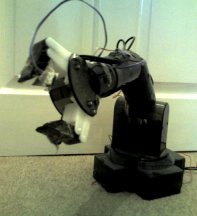
Toy Robot ArmRobot Arms

Robot arms are often used in industrial manufacturing processes. They are gradually replacing human laborers as they can work non stop 24/7, and the work they produce is highly precise and repeatable. New robotic systems may be very expensive to set up, but they will often generate enough revenue to cover the initial costs in a matter of months.

Most industrial robots functions are done 'blind'. This means that it is simply following pre-programmed moves in sequence, without using sensors (except position encoders) to verify that it is functioning correctly.

This method is commonly used as it is much cheaper than others, but it also has its drawbacks. An accidental collision will cost a lot to fix. Not only is production stopped, but also the tool needs to be millimeter perfect due to the 'blind' action of the robot.

Simply replacing the damaged parts is not always possible as it is extremely difficult to get an exact replacement. Often the robot must be reprogrammed to compensate for the slight differences in the new parts.

Robot News

CMU Launches $7 Million Educational Initiative

The CMU Robotics Institute, with the help of a seven million dollar DARPA grant, has announced the launch of a four year educational initiative called Fostering Innovation through Robotics Exploration (FIRE). The goal is to use student interest in robotics to encourage computer science education, and to steer students toward science and engineering careers. In addition to embracing existing educational robotics competitions such as FIRST and VEX, CMU will also be creating new competitions.

The initiative will ... create new competitions for autonomous, multi-robot teams and for computer animations that will attract a broader array of students and offer new challenges.

To help, CMU is tapping robot expertise from Dallas, TX, hiring none other than Ed Paradis, current president of the Dallas Personal Robotics Group. When asked about the propsect of leaving one of the nation's top Hobby Robot Groups for CMU, he replied, "although I'm sad to leave the Dallas robotics community, this is a hobby roboticists dream job!". More..

Robots: Nanosystems
"There's Plenty of Room at the Bottom", as Richard Feynman famously pointed out during a talk in 1959. And a lot of progress has been made since: The latest episode of the Robots podcast takes a look at nanorobotics and the current state of the art concerning nano robot hardware and control. The first guest is Ari Requicha, who is the founder of the Laboratory for Molecular Robotics (LMR) at the University of Southern California and editor-in-chief of IEEE Transactions on Nanotechnology. The second guest is Grégory Mermoud, who is currently finishing his PhD at the Distributed Intelligent Systems and Algorithms Lab at the EPFL. For more on the state of the art in nano robotics read on or tune in! More..

Next Page: Robotics Research
Previous Page: History of Robotics

Science Menu

Research projects Research Projects

DIY ProjectsDIY Projects & Experiments
CyberneticsCybernetics & Virtual Worlds
High VoltageHigh Voltage
PropulsionPropulsion Systems
PhysicsPhysics & Formula

Info Box

Power Pulse ModulatorPower Pulse Modulator
Variable Frequency, Variable Pulse Width, up to 100A DC Pulse Control Circuits More....

We Ship Worldwide

Customer Feedback

"Thanks for the great service!"

"Awesome job guys, thanks!"

"Thanks my PPM works flawlessly it's the best coil driver I have ever used!"

Questions and Comments on the Artificial Intelligence Research

The information provided here can not be guaranteed as accurate or correct. Always check with an alternate source before following any suggestions made here.
AristhSunday, 21st September 2008 1:21am - No.3130
Excuse me, I would like to know what company made the small robot arm.
javm_jose@hotmail.com
 
RMCyberneticsTuesday, 23rd September 2008 1:55pm - No.3132
What robot arm?
 
MikeSaturday, 17th January 2009 6:34pm - No.3488
Hi,
I have been playing with vrml and X3d now for about 10 years.
Some of my projects have been for work at the national lab I work for (sorry can't let you see those) but I have some others I will let you see in a bit.
My question for you guys is what browser extensions do you use? I have found that there are none that will do everything and few hat do all of the things i want to do.
I use cortona for vrml 95 and vrml 1. For X3d and use with javascript for ajax3d I find that only flux3d is able to handle it without crashing.
ajax3d allows better access to databases and inputs from things like data sampling (for do 3d animation of a sampled process or plant status in real time.)
For 3d input in my worlds I have experimented with using a P5 glove as well and a 6 degrees of freedom ball mouse.


Click the button to leave your comment or question
Power PWMHigh Power Pulse Width Modulated Signal Generators High Power HHO ElectrodesElectrodes for Hydrogen and Oxygen production Power Pulse ModulatorVariable Frequency PWM Circuits Aura Plasma Photography PlatesAura Photo Electrodes

© 2010 All Rights Reserved

About Us | Terms of Use | Services